Affichage des articles dont le libellé est services financiers mobiles. Afficher tous les articles

mercredi 27 novembre 2013

Is Bitcoin about to change the world?

If you want to buy drugs or guns anonymously online, virtual currency Bitcoin is better than hard cash. Canny speculators have been hoarding it like digital gold. Now the world's leading bankers are even talking about as a rival for real money. How does it work, where can you get it and is it the future.
A sign above a bar in Germany.
A sign above a bar in Germany. Photograph: Alamy
The past weeks have seen a surprising meeting of minds between chairman of the US Federal Reserve Ben Bernanke, the Bank of England, the Olympic-rowing and Zuckerberg-bothering Winklevoss twins, and the US Department of Homeland Security. The connection? All have decided it's time to take Bitcoin seriously.
Until now, what pundits called in a rolling-eye fashion "the new peer-to-peer cryptocurrency" had been seen just as a digital form of gold, with all the associated speculation, stake-claiming and even "mining"; perfect for the digital wild west of the internet, but no use for real transactions.
Bitcoins are mined by computers solving fiendishly hard mathematical problems. The "coin" doesn't exist physically: it is a virtual currency that exists only as a computer file. No one computer controls the currency. A network keeps track of all transactions made using Bitcoins but it doesn't know what they were used for – just the ID of the computer "wallet" they move from and to.
Right now the currency is tricky to use, both in terms of the technological nous required to actually acquire Bitcoins, and finding somewhere to spend them. To get them, you have to first set up a wallet, probably online at a site such as Blockchain.info, and then pay someone hard currency to get them to transfer the coins into that wallet.
A Bitcoin payment address is a short string of random characters, and if used carefully, it's possible to make transactions anonymously. That's what made it the currency of choice for sites such as the Silk Road and Black Market Reloaded, which let users buy drugs anonymously over the internet. It also makes it very hard to tax transactions, despite the best efforts of countries such as Germany, which in August declared that Bitcoin was "private money" in which transactions should be taxed as normal.
It doesn't have all the advantages of cash, though the fact you can't forge it is a definite plus: Bitcoin is "peer-to-peer" and every coin "spent" is authenticated with the network. Thus you can't spend the same coin in two different places. (But nor can you spend it without an internet connection.) You don't have to spend whole Bitcoins: each one can be split into 100m pieces (each known as a satoshi), and spent separately.
Although most people have now vaguely heard of Bitcoin, you're unlikely to find someone outside the tech community who really understands it in detail, let alone accepts it as payment. Nobody knows who invented it; its pseudonymous creator, Satoshi Nakamoto, hasn't come forward. He or she may not even be Japanese but certainly knows a lot about cryptography, economics and computing.
It was first presented in November 2008 in an academic paper shared with a cryptography mailing list. It caught the attention of that community but took years to take off as a niche transaction tool. The first Bitcoin boom and bust came in 2011, and signalled that it had caught the attention of enough people for real money to get involved – but also posed the question of whether it could ever be more than a novelty.
The algorithm for mining Bitcoins means the number in circulation will never exceed 21m and this limit will be reached in around 2140. Already 57% of all Bitcoins have been created; by 2017, 75% will have been. If you tried to create a Bitcoin in 2141, every other computer on the network would reject it as fake because it would not have been made according to the rules of currency.
The number of companies taking Bitcoin payments is increasing from a small base, and a few payment processors such as Atlanta-based Bitpay are making real money from the currency. But it's difficult to get accurate numbers on conventional transactions, and it still seems that the most popular uses of Bitcoins are buying drugs in the shadier parts of the internet, as people did on the Silk Road website, and buying the currency in the hope that in a few weeks' time you will be able to sell it at a profit.
This is remarkable because there's no fundamental reason why Bitcoin should have any value at all. The only reason people are willing to pay money for the currency is because other people are willing to as well. (Try not to think about it too hard.) Now, though, sensible economists are saying that Bitcoin might become part of our future economy. That's quite a shift from October last year, when the European Central Bank said that Bitcoin was "characteristic of a Ponzi [pyramid] scheme". This month, the Chicago Federal Reserve commented that the currency was "a remarkable conceptual and technical achievement, which may well be used by existing financial institutions (which could issue their own bitcoins) or even by governments themselves".
The First Bitcoin ATM, in Canada.The First Bitcoin ATM, in Canada. Photograph: REUTERS
It might not sound thrilling. But for a central banker, that's like yelling "BITCOIIINNNN!" from the rooftops. And Bernanke, in a carefully dull letter to the US Senate committee on Homeland Security, said that when it came to virtual currencies (read: Bitcoin), the US Federal Reserve had "ongoing initiatives" to "identify additional areas of … concern that require heightened attention by the banking organisations we supervise".
In other words, Bernanke is ready to make Bitcoin part of US currency regulation – the key step towards legitimacy.
Most reporting about Bitcoin until now has been of its extraordinary price ramp – from a low of $1 in 2011 to more than $900 earlier this month. That massive increase has sparked a classic speculative rush, with more and more people hoping to get a piece of the pie by buying and then selling Bitcoins. Others are investing thousands of pounds in custom "mining rigs", computers specially built to solve the mathematical problems necessary to confirm a Bitcoin transaction.
But bubbles can burst: in 2011 it went from $33 to $1. The day after hitting that $900 high, Bitcoin's value halved on MtGox, the biggest exchange. Then it rose again.
Speculative bubbles happen everywhere, though, from stock markets to Beanie Babies. All that's needed is enough people who think that they are the smart money, and that everyone else is sufficiently stupid to buy from them. But the Bitcoin bubbles tell us as much about the usefulness of the currency itself as the tulip mania of 17th century Holland did about flower-arranging.
History does provide some lessons. While the Dutch were selling single tulip bulbs for 10 times a craftsman's annual income, the British were panicking about their own economic crisis. The silver coinage that had been the basis of the national economy for centuries was rapidly becoming unfit for purpose: it was constrained in supply and too easy to forge. The economy was taking on the features of a modern capitalist state, and the currency simply couldn't catch up.
Describing the problem Britain faced then, David Birch, a consultant specialising in electronic transactions, says: "We had a problem in matching the nature of the economy to the nature of the money we used." Birch has been talking about electronic money for over two decades and is convinced that we find ourselves on the edge of the same shift that occurred 400 years ago.
A Bitcoin wallet on a smartphone.A Bitcoin wallet on a smartphone. Photograph: Bloomberg via Getty Images
The cause of that shift is the internet, because even though you might want to, you can't use cash – untraceable, no-fee-charged cash – online. Existing payment systems such as PayPal and credit cards demand a cut. So for individuals looking for a digital equivalent of cash – no middleman, quick, easy – Bitcoin looks pretty good.
In 1613, as people looked for a replacement for silver, Birch says, "we might have been saying 'the idea of tulip bulbs as an asset class looks pretty good, but this central bank nonsense will never catch on.' We knew we needed a change, but we couldn't tell which made sense." Back then, the currency crisis was solved with the introduction first of Isaac Newton's Royal Mint ("official" silver and gold) and later with the creation of the Bank of England ("official" paper money that could in theory be swapped for official silver or gold).
And now? Bitcoin offers unprecedented flexibility compared with what has gone before. "Some people in the mid-90s asked: 'Why do we need the web when we have AOL and CompuServe?'" says Mike Hearn, who works on the programs that underpin Bitcoin. "And so now people ask the same of Bitcoin. The web came to dominate because it was flexible and open, so anyone could take part, innovate and build interesting applications like YouTube, Facebook or Wikipedia, none of which would have ever happened on the AOL platform. I think the same will be true of Bitcoin."
For a small (but vocal) group in the US, Bitcoin represents the next best alternative to the gold standard, the 19th-century conception that money ought to be backed by precious metals rather than government printing presses and promises. This love of "hard money" is baked into Bitcoin itself, and is the reason why the owners who set computers to do the maths required to make the currency work are known as "miners", and is why the total supply of Bitcoin is capped.
And for Tyler and Cameron Winklevoss, the twins who sued Mark Zuckerberg (claiming he stole their idea for Facebook; the case was settled out of court), it's a handy vehicle for speculation. The two of them are setting up the "Winklevoss Bitcoin Trust", letting conventional investors gamble on the price of the currency.
Some of the hurdles left between Bitcoin and widespread adoption can be fixed. But until and unless Bitcoin develops a fully fledged banking system, some things that we take for granted with conventional money won't work.
Others are intrinsic to the currency. At some point in the early 22nd century, the last Bitcoin will be generated. Long before that, the creation of new coins will have dropped to near-zero. And through the next 100 or so years, it will follow an economic path laid out by "Nakomoto" in 2009 – a path that rejects the consensus view of modern economics that management by a central bank is beneficial. For some, that means Bitcoin can never achieve ubiquity. "Economies perform better when they have managed monetary policies," the Bank of England's chief cashier, Chris Salmon, said at an event to discuss Bitcoin last week. "As a result, it will never be more than an alternative [to state-backed money]." To macroeconomists, Bitcoin isn't scary because it enables crime, or eases tax dodging. It's scary because a world where it's used for all transactions is one where the ability of a central bank to guide the economy is destroyed, by design.
For Bitcoin developer Hearn, that's not a concern. "Bitcoin's monetary policy would only be relevant if it were to be adopted by an entire economy, which isn't going to happen any time soon."
Already, alternatives based on Bitcoin have sprung up: for instance, Litecoin speeds up transaction processing and Freicoin introduces measures to stop people hoarding their money, but both are essentially the same technology, "forked" from the original. There's even nothing to stop a nation state declaring its own version of Bitcoin as legal tender.
So even if the currency of the future looks like Bitcoin, it might end up being a distant successor of the pioneer. "Is the technology of Bitcoin a window into the future?" asks Birch. "Yes. Is Bitcoin itself? No."
Source : The Guardian

mercredi 13 novembre 2013

Boku permet de payer sa place de parking d’un simple sms

BokuLes services de carrier billing se multiplient, simplifiant le paiement et poussant les géants high-tech à nouer des partenariats pour intégrer ces fonctionnalités.
Usages en plein expansion dans le domaine du m-paiement, les services de carrier billing permettent aux utilisateurs de payer divers produits notamment sur les réseaux sociaux et plateformes d’applications en utilisant des crédits téléphoniques pouvant être directement mobilisés par sms. Paradoxalement il s’agit de l’une des formes les plus anciennes de paiement sur mobile, développés dès l’apparition des premiers appareils pour acheter des fonds d’écran ou sonneries spécifiques par exemples. Mais aujourd’hui il s’agit d’un service  indispensable au développement dumarché des applications estimé à près de 25 milliards de dollars. Plusieurs acteurs tentent à présent d’intégrer ces services mobiles dans des usages du quotidien.

Le carrier billing à l’assaut du monde réel

L’entreprise de carrier billing basée à San Francisco,Boku après avoir développé ses services sur différentes plateformes et réseaux sociaux étend son marché au monde réel avec un premier partenariat. En collaboration avec PassportParking l’entreprise permet aux usagers de plusieurs grandes villes américaines de payer leurs places de parking directement par sms, mettant fin ainsi aux appoints approximatifs aux parcmètres. Cette incursion d’un service à l’origine exclusivement digital dans des usages quotidiens et physiques marque une étape menant à la généralisation du carrier billing.  Boku utilise en effet la même technique au cœur de sa chaîne de valeur d’origine, les utilisateurs de PassportParking payent directement leur facture grâce à leur numéro de téléphone, le montant étant déduit du forfait géré par l’opérateur et nom d’un compte en banque ou autre porte-monnaie digital.  

Une tendance qui affecte les géants du e-commerce et des mobiles

Le carrier billing  s’affirme de plus en plus comme tendance de fond affectant transversalement les acteurs digitaux, comme le souligne Jon Prideaux CBO de Boku : « Depuis un an, le carrier billing s’impose progressivement comme une méthode de paiement privilégiée sur des nouveaux appareils connectés comme la TV connectée ou encore les nouvelles consoles de jeux . » Amazon a ainsi annoncé il y a quelques mois un partenariat avec Bango, l’un des leaders mondiaux du carrier billing pour offrir à ses clients la possibilité de payer leurs achats grâce à leurs crédits téléphoniques.  Ce partenariat devrait se concrétiser sous la forme d’application Amazon pour Android, la tendance du carrier billing se répandant à la fois chez les acteurs de l’e-commerce et chez les développeurs d’appareils connectés ( mobiles, tablettes etc). De même Microsoft offre maintenant l’application Bango sur son Windows Phone Store, visant dans un premier temps le marché de l’Asie du Sud-Est avant de s’étendre globalement.
Source : L'Atelier

jeudi 10 octobre 2013

La Banque Postale teste le paiement vocal en ligne

Après avoir enregistré sa voix, l'application Talk to Pay déclenche un appel sur le mobile de l'utilisateur pour l'identifier avant de remplir pour lui le formulaire de paiement. 


Cherchant à relever le défi de l'authentification des acheteurs en ligne, la Banque Postale expérimente depuis mi-septembre une solution de paiement vocal. Autorisé le mois dernier par la Cnil et conçu avec PWC, Talk to Pay sera testé par 500 clients et collaborateurs de la banque pendant les 12 prochains mois. Concrètement, l'utilisateur doit d'abord enregistrer sa voix sur le site de l'expérimentation, qui crée un modèle biométrique lui étant propre. Il renseigne ensuite ses coordonnées bancaires puis Talk to Pay s'installe automatiquement sur son navigateur Web. Lorsqu'il finalise un achat en ligne, l'application déclenche un appel sur son mobile. Dès que l'utilisateur s'est identifié par la voix, elle remplit pour lui les informations de paiement par carte bancaire. Le cryptogramme visuel habituellement demandé est par ailleurs remplacé par un code aléatoire à usage unique généré par Talk to Pay.

La Banque Postale conclut que ce système d'authentification vocale pourrait dans un second temps servir à identifier des clients sur des serveurs vocaux ou à sécuriser leur accès à des banques en ligne.

Source : Journal Du Net

lundi 22 juillet 2013

MBank And The Future Of Responsive Banking


I’m not a huge fan of banks, but when senior director Michal Panowicz approached me about mBank, my interest was piqued. How could a banking spin-off of BRE Bank and founded in 2000 create one of the coolest, most high-tech banking experiences I’ve seen? The more important question, however, was how could a Polish bank beat the big guys — the Chases, the Citibanks, and the Credit Suisses of the world — to the punch in terms of improved user experience and unique features? 
In short, a small group of programmers and finance guys in Warsaw, Poland, did what the rest of the world couldn’t. And, more importantly, they were quite successful.


John Biggs interviews Michal Panowicz of mBank from ReaktorWarsaw.com on Vimeo.

MBank, in its current incarnation, is very nearly a startup. While they still get some funding from their parent organization, mBank was designed to be a greenfield operation and work independently from the staid old banks that aggravated customers with long lines and odd rules. Now, however, it’s a snappy, surprisingly usable web-only service that lets customers view their transactions using user-experience rules that are more familiar to Steam users than bank customers.

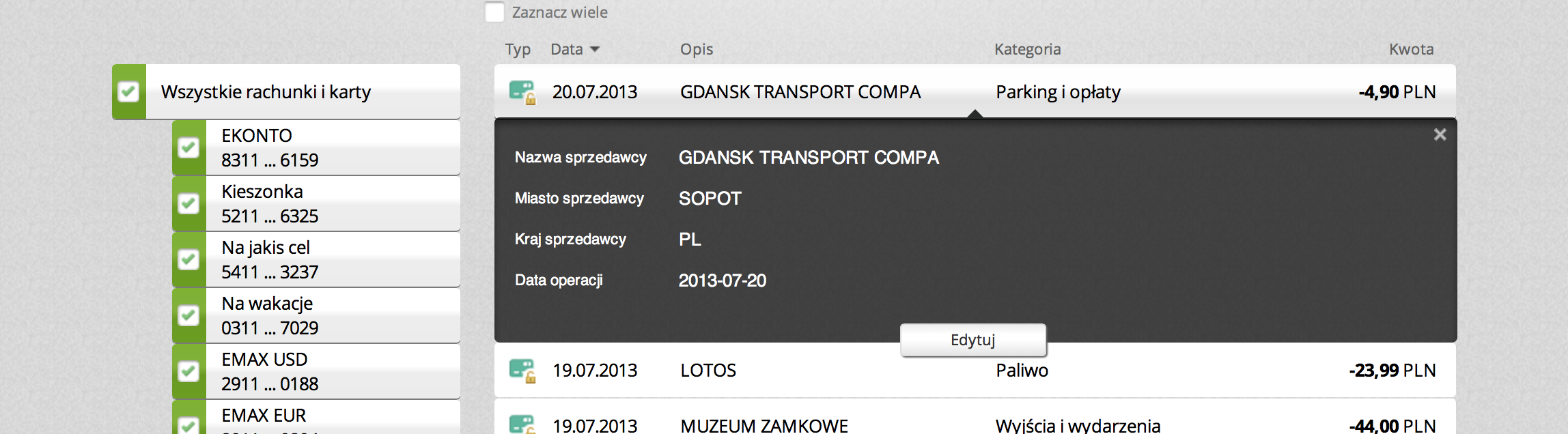
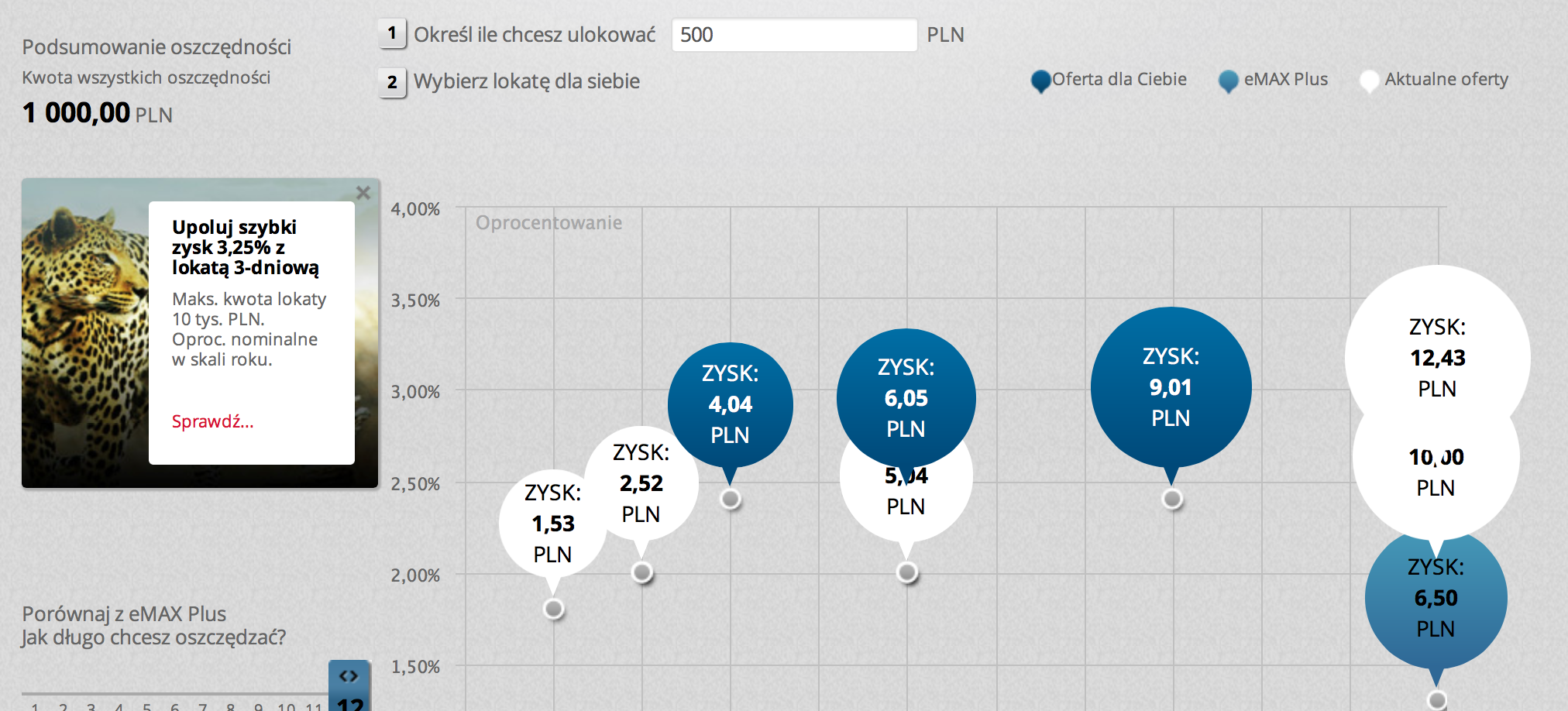
The new mBank is built on a completely responsive design that uses HTML5 and UI tricks to create a unique experience that is more reminiscent of a Windows 8 app than a bank website. While other bank websites show a list of transactions and little else, mBank can show you where those purchases appear in your overall account balance and how and where they fit into your budget. This is done with some clever animations and dynamic objects that are as modern and sleek as an app.
Screen Shot 2013-07-20 at 7.46.53 PM
Screen Shot 2013-07-20 at 7.50.34 PM

To be clear, banks are still pretty boring. However it’s important that mBank is trying something new. If my own bank, Chase, had something like this — complete with mBank’s gamification aspects, as well as its clever deal offers that mimic the best of Groupon and Pinterest — I’m sure I’d be far more interested in staying on the site. By making the site, for lack of a better word, fun, mBank has changed the relationship between bank and customer. This is important in almost any B2C environment and more important when the traditional customer/business relationship in banking has always been vaguely adversarial. mBank isn’t better, per se, but has done far more about user experience than any other bank I’ve seen. That’s what’s important here — the attention to detail.

I spoke with Panowicz at our Warsaw meet-up and thought it would be interesting to get his input on how to turn a banking website around in a few short years. Panowicz is a former Microsoft employee and a true technophile. He brought a unique vision to a 10-year-old company and turned it around, which is quite important.

Source: Techcrunch, John Biggs

samedi 4 mai 2013

BII REPORT: How Banking Is Going Mobile


Over the years, retail banks have innovated to make personal banking more convenient and consumer-friendly.
They've built sprawling branch networks, introduced credit cards, and developed automatic teller machines.


In its latest evolution, banking is going mobile. With smartphones and tablets increasingly at the center of financial decisions — especially those of younger consumers — banks have to get their mobile strategies right. If they don't, they risk losing business to more mobile-savvy competitors, as well as tech companies like PayPal, that are developing their own payment and personal finance solutions.
In a recent report from BI Intelligence we examine mobile banking's growth spurt, analyze consumer adoption behavior and barriers, detail the competition to develop the best mobile banking tools, take a look at some banking app pioneers and cutting-edge features, detail how mobile banking could be bottom-up, expanding bank and credit access worldwide, and touch on how this race affects the closely-related business in mobile payments.

Here's a brief overview of the current state of mobile banking: 


Read more: http://www.businessinsider.com/how-banking-is-going-mobile-2013-5#ixzz2SJjbDWUF

Source : Business Insider, May 3, 2013, 

HBL launches branchless banking


KARACHI: Habib Bank Limited (HBL), Pakistan’s largest bank, has launched branchless banking service ‘HBL Express’.

Kazi Abdul Muktadir, acting governor of State Bank of Pakistan and Nauman Dar, President and CEO of HBL, were present at the launching ceremony.

Speaking on the occasion, Nauman Dar said: “HBL Express is another step by HBL towards achieving its vision of supporting financial inclusion in the country.

It will provide convenient and reliable banking services to the people of Pakistan.”

HBL Express will be launched with domestic remittances and utility bill payments. The product portfolio will be expanded to include international remittances, mobile wallets, G2P payments and corporate solutions in the near future.

“Pakistan’s branchless banking model supported by banks is considered amongst the best in the world,” Kazi Abdul Muktadir said. “In a country where over 90 percent of the population is unbanked, HBL Express supported by the bank’s distribution network will help recruit new users to mainstream banking.”


Source : News Desk, Wednesday, May 01, 2013, From Print Edition

mardi 30 avril 2013

The End of PoS As We Know It


I have just been to the Apple Store with my daughter as she wanted to replace her broken smartphone. Can you guess what the person working there used to take a picture of the damage, bring up my customer data, take the credit card payment, and send the invoice to me by e-mail? He didn't use a camera, or a pen, or a traditional cash register, or a printer. That's right. He did it all on an iPad.
US retailer Urban Outfitters announced late last year that it had ordered its last ever cash register. The clothing chain declared it would start equipping sales staff with iPads instead. Many other retailers have also announced plans to phase out cash registers, including JCPenney, Aeropostale, Sam’s Club and Nordstrom. Others are likely to follow. Retailers have good reasons to eliminate cash registers says Gary Lombardo, Head of Marketing at Demandware. In fact, he believes that, at the current pace, mobile devices could replace cash registers in just a few years. Is this the end of PoS as we know it?
The Beginning of the End
Point-of-Sale (also known as 'Point of Service' or just ‘POS’) devices such as touch-screen displays, barcode scanners, receipts printers, scales and pole displays are slowly being forced out of the retail environment by the wide presence and capabilities of smartphones and tablets. The rise of online and mobile commerce has led retailers and POS technology providers to rethink how to best serve consumers.
Integration is one avenue. Due the potentially advantageous ROI and the worldwide exposure mobile platforms can provide, US developer and distributor POSmatic has come up with Onsight Point of Sale Software. Onsight offer SMEs a one-stop integrated solution to processing secure payments from “electronic signature capture pads, debit and credit card payments, web-enabled platforms, and smart interfaces.” Accepting mobile payments is rising in importance with retailers feeling the pinch of recession or simple loss of walk-in customers into their physical stores.
Apple devices are another option. Urban Outfitter’s CIO, Calvin Hollinger, said during a webcastpresentation in September 2012, that “iPads cost about 1/5th as much as a cash register, and can be used for so much.” Additional benefits of using iPads for retail transactions, according to Business Insider, include customer interaction, as they can enter their name, address and even telephone number and e-mail address easily and comfortably on an iPad. What’s more, “an iPad on a swivel that’s not in use can quickly be taken off, with that space being used for packing or more merchandise or anything else” says the article’s author Joe Weisenthal.
Dynamic Payment Processing
Mobile Strategy Partner’s David Eads argues new problems associated with managing multichannel shopping and measuring performance can be solved using mobile devices. Rather than upgrade POS equipment to serve mobile payments and NFC technology, Eads says smartphones and tablets offer a more dynamic way of handling all types of payment and monitoring sales across a range of channels.
IT company (and POS developer) Oracle’s David Dorf was (understandably) cautious about calling time on the point of sale as we know it. In a blog post from last year, Dorf wrote that, “in some situations, for some retailers there might be an opportunity to ditch the traditional POS, but for the majority of retailers that’s just not practical. Self-checkout is a great addition to POS and so is mobile checkout,” he argues. “But they add capabilities to POS, not replace it. Centralized architectures, even those based in the cloud, are quite viable as long as there’s resiliency in the registers.”
Whether PoS is enhanced by mobile devices such as smartophones and tablets, or replaced altogether, what is sure is that our shopping experience is set to change forever with the advent of mobile commerce.
Do you agree with that vision? Share your thoughts below.
Posted by Herwig Stockl on 19 Apr, 2013
Source : Ericsson

jeudi 7 février 2013

Banks Using Big Data to Discover ‘New Silk Roads’

JPMorgan Chase & Co., the largest commercial bank in the U.S., generates a vast amount of credit card information and other transactional data about U.S. consumers. Several months ago, it began to combine that database, which includes 1.5 billion pieces of information, with publicly available economic statistics from the U.S. government. Then it used new analytic capabilities to develop proprietary insights into consumer trends, and sell those reports to the bank’s clients. The technology allows the bank to break down the consumer market into smaller and more narrowly identified groups of people, perhaps even single individuals. And those new reports can be generated in seconds, instead of weeks or months, JPMorgan Chase CIO Guy Chiarello told CIO Journal.

It’s an example of how the nation’s four large universal banks—JPMorgan Chase Bank of America Corp. Citigroup Inc. and Wells Fargo & Co. — are beginning to make use of potentially powerful analytic technology known as Big Data, which describes a broad set of hardware and software and is designed to quickly process huge amounts of data, including information like social media posts and email, which don’t fit into conventional databases.
John Moore/Getty Images

The software can help analyze internal bank records and correlate them with other sources of information–to give banks a more accurate picture of their customers, and a better ability to predict which customers are likely and credit-worthy buyers of new financial products.

“Big Data is really the theme for 2013,” says Mr. Chiarello. He says that Big Data-driven “digital marketing will become a significant thing.” Currently, as with most large banks that have had to swallow acquisitions that further muddled traditionally siloed banking operations, JPMorgan Chase has a hard time aggregating all available information about a single customer. Information about checking accounts, mortgages and wealth management for the same individual were contained in independent information management systems, preventing banks from leveraging considerable analytic capabilities that could have helped account representatives provide customers with better service. Banks can also offer lower interest rates by using Big Data to reduce credit card fraud, thus reducing their overhead, says Mr. Chiarello. “We should be able to be a better credit bureau than the credit bureaus,” he said.

This opportunity comes at a time when banks are under enormous margin pressure thanks to a slack economy, and they have little room for extra spending on technology. Whatever spending they’re doing on emerging technology is coming from savings they’ve achieved by rationalizing their technology operations. Their ambitions include the use of real-time analytics, creating better mobile offerings, and further cost reduction through the use of more sophisticated ATMs. The question is whether they have enough to spend, and can create new products to create incremental revenue and put the brakes on customer churn.

The four big universal banks, far and away the U.S.’s largest banks with over one trillion dollars in assets, each spend approximately $7 billion to $10 billion annually on technology, according to Howard Rubin, principal at bank technology advisory firm Rubin Worldwide. Mr. Rubin would not discuss individual banks because many are clients of his firm. The banks do not publicly discuss technology spending separately from operations, in part because traditionally, spending on technology has been up to individual business units. Market research firm Ovum estimates that U.S. banks will spend $41.5 billion on technology in 2013.

Budget pressure notwithstanding, the big banks are moving into Big Data. Jeff Harte, a bank analyst with Sander O’Neill, says lenders are moving beyond traditional analysis of customers’ credit-worthiness and “are analyzing the behavior of customers,” seeking answers to questions such as whether they always eat dinner out or whether they offset shopping at high-end department stores with trips to discount stores. This information can be gleaned from credit and debit card statements as well as from posts to social media sites. “It’s a step beyond analyzing credit quality and towards analyzing the customers’ behavior,” he said.

Steve Ellis, executive vice president and group head of the Wells Fargo Wholesale Services Group, says “the behavioral analysis stuff is coming” in the next five years. He warns, however, that there’s still a lot to understand for the banks to learn before they can “get to one-to-one marketing. That’s the big promise, and that’s where competitive advantage will be played out in lots of industries over the next five years. And if you don’t figure it out, you’re not going to be best in class.”

Catherine Bessant, who runs technology and operations at Bank of America, says BoA used the analytic capabilities of Big Data to understand why many of its commercial customers were defecting to smaller banks. Until recently, it offered an end-to-end cash management portal which, it learned thanks to its analytic capabilities, was too rigid for its customers, who wanted the freedom to access ancillary cash management services from other financial services firms. “We started to get beat by smaller banks that could deliver more modular solutions,” says Ms. Bessant. Bank of America used data gleaned from customer behavior on its own website as well as from call center logs and transcripts of one-on-one customer interviews to determine why it was losing those customers. It dropped the all-in-one offering and launched a more flexible online product, Cash Pro Online, in 2009, and a mobile version, Cash Pro Mobile, in 2010, even though the previous product “had been seen as a cash cow,” she says. All the development work had already been done, which meant new business “went straight to the bottom line.”

Citi, for its part, is experimenting with new ways of offering commercial customers transactional data aggregated from its global customer base, which clients can use to identify new trade patterns. “New silk roads are being created, and we think this information could show signs for which might be the next big cities in emerging markets,” says Don Callahan, who manages internal operations and technology at Citi. According to Mr. Callahan, the bank shared such information with a large Spanish clothing company which it was able to use to determine where to open a new manufacturing facility and several new stores.

The banks believe Big Data can help them grow revenue in a slack market. Thomas Sanzone, a senior vice president at consulting firm Booz Allen Hamilton who advises financial services firms, says Big Data represents “a significant opportunity for cross-selling and customized marketing because you have new technologies and techniques that give you access to pools of data that used to be unreachable. That changes the game and can create significant opportunities you didn’t have before.”
Banks executives also hope Big Data will help them use better marketing techniques to address a big problem with customer churn.  JP Morgan Chase said in an investor’ day presentation in 2011 that it expected between 50% and 60% of its customers to leave as a result of new fees on checking accounts.

But first the banks must find room in the budgets to fund these initiatives. In many instances, investments in innovation are being funded by savings accomplished through rationalizing systems and automating processes.

Citi, which announced a large reorganization in December, with approximately a quarter of the savings coming from its operations and technology unit, reduced overall spending in O&T by more than $4 billion over five years, according to Mr. Callahan.

Kevin Rhein, senior executive vice president of technology and operations at Wells Fargo & Co., says the bank has largely completed the work of integrating scores of different systems, and almost two years ago began the work of moving “to the next stage of technology and operations.” For the three previous years, “we spent a lot of money on integration, and there’s a lot of pent-up demand [for technology services] as a result of that. He said approximately 80% of the company’s technology spending is now on new services and capabilities requested by the business units. Still, he said, “I think we are under-investing” in technology. “I’d like to be investing more,” he said during an on-stage Q&A with the Wall Street Journal at a CIO event sponsored by consulting firm Gartner Inc.
Mr. Chiarello said JP Morgan is plowing savings from having consolidated technology units into new initiatives around technology. But “net spend is flat from 2007,” he said. “And that’s with more investment in innovation.”

Mr. Harte of Sander O’Neill says JP Morgan and Wells Fargo are some 12 to 18 months ahead of Citigroup and Bank of America in terms of folding in the systems of merged banks, giving them a lead in the innovation race, but that the latter are catching up quickly. “The ones who got through the crisis in better shape had a head start of around six to eight months, but the others are closing ground quickly,” he said.

Bank of America has been able to shift the bulk of technology spending from activities around consolidation to investing in more innovative technologies, such as Big Data. But Ms. Bessant says the banks also must make cultural adaptations if they hope to make a good return on these types of investment.  The leaders of those large institutions must be willing to absorb unwelcome news—such as accepting that customers are unhappy about a particular service, and why — and change as a result.

The promise of Big Data is “the manufacturing of brilliant data and making brilliant use of it, and we have a drive for abject purity in listening,” she said.

By Michael Hickins
Source: Wall Street Journal 

jeudi 24 janvier 2013

La micro-assurance mobile : définition, enjeux, perspectives [Publication Innhotep]

Dans la publication ci-contre, Innhotep livre son analyse de la micro-assurance, et plus particulièrement du rôle crucial que sont amenées à jouer les technologies et services mobiles.


jeudi 10 janvier 2013

Titres restaurants sur mobile : une innovation!

Start-up innovante et véritable précurseur, Resto Flash entend révolutionner le paiement mobile en lui donnant un usage quotidien grâce à ses titres restaurants sur téléphone portable.

Titres restaurants sur mobile : ceci est une innovation!
Resto Flash est la nouvelle application de paiement sur mobile qui permet aux salariés d’utiliser leur téléphone pour payer leur déjeuner avec des titres restaurants. Cela représente d’emblée un marché de 3,5 millions de transactions par jour rien qu’en France – sans parler des 35 autres pays où l’on trouve des dispositifs équivalents.

Le système Resto Flash repose sur deux applications mobiles: une application pour le salarié (disponible gratuitement sur Google Play, l’Appstore ou via webapp), et une application pour le restaurateur.

L’application utilisateur
Elle permet au salarié de recevoir chaque mois les titres crédités par son employeur directement sur son mobile. Pour payer avec Resto Flash, il sélectionne un titre d’un simple glissé de doigt, ce qui génère un flashcode avec toutes les informations et mentions légales pour assurer une transaction simple, sécurisée et instantanée.

L’application restaurateur
Le restaurateur confirme la validité du titre en scannant le flash code avec un téléphone portable dédié, transformé en terminal de paiement : en quelques secondes la transaction est approuvée, transmise au serveur Resto Flash et le titre « invalidé ».
Le remboursement est ensuite effectué depuis le compte titre restaurant de Resto Flash vers le compte bancaire du restaurateur, dans les délais d’un virement.

Un back office pour des titres numériques « équivalent papier »
Le système Resto Flash gère de bout en bout le cycle de vie des titres restaurant numériques : commande, émission, gestion, encaissement, invalidation et compensation ; à chaque étape, les politiques d’horodatage, signature et archivage mises en place assurent la valeur probante des titres Resto Flash, équivalents aux traditionnels titres papier, conformément à la réglementation en vigueur.

Le numérique interdit la fraude, le vol ou la réutilisation des titres, protégeant ainsi restaurateurs comme utilisateurs. En outre, la technologie brevetée de Resto Flash assure une transaction de mobile à mobile d’une rapidité et d’une simplicité inégalées.

BK
Source : Mitinews

mercredi 12 décembre 2012

Fortune Exclusive: Larry Page on Google

121211083220-larry-page-google-gallery-verticalThe press-shy Google CEO talks about mobile computing, his tussles with Apple -- and the future of search.

FORTUNE -- Last month, Larry Page sat down with Fortune Senior Writer Miguel Helft for a lengthy interview for a forthcoming Fortune magazine article. It was only Page's second wide-ranging conversation with a print publication since becoming CEO of Google in April 2011. The 70-minute discussion covered, among other things, Page's take on the future of search, his plans to integrate Motorola and how his management style has changed since taking the helm of the company. Edited excerpts follow.

Fortune: When you're thinking about the next bet you're going to make, how do you pick?
Larry Page: That's something we've been thinking about a lot. Unfortunately, there's not a perfect science to that. Partly I feel that Google is in uncharted territory in the sense that I don't think there's an example from history I can take and say: "Why don't we just do that?" We're at a pretty big scale. We're doing a lot of different things. We want to be a different kind of company. We'd like to have more of a social component in what we do. We like people to be happy with the products they're using. We like our employees to be happy about working here.
Sorry, back to your main question: Choosing what to do. We want to do things that will motivate the most amazing people in the world to want to work on them. You look at self-driving cars. You know a lot of people die, and there's a lot of wasted labor. The better transportation you have, the more choice in jobs. And that's social good. That's probably an economic good. I like it when we're picking problems like that: big things where technology can have a really big impact. And we're pretty sure we can do it. And whatever the technology investment we need to do that, it's not going to be that huge compared to the payoff.

What else would change [in a world with self-driving cars]? Would we not have streetlights? Would the cities be different? Do you have a vision for what could happen?
It's very hard to predict entirely. I think that, you know, one of the issues we face here is parking. I'm getting quotes [for] the cost for us to build a parking lot structure [of] $40,000 per space. It's all concrete and steel. Do you really want to use all your concrete and steel to build parking lots? It seems pretty stupid. If we have automated cars, or even if we have some fraction of automated cars, we'll save hundreds of millions of dollars on parking, just at Google. When you think about your experience, the car can drop you at the front door to the building you work at and then it goes and parks itself. Whenever you need it, your phone notices that you're walking out of the building, and your car's there immediately by the time you get downstairs.

Let me bring you back to management in the company. One of your big early changes was to organize the company around product groups. Are you satisfied with what it's accomplished. If part of it was about getting faster, have you gotten faster? How do you measure that?
It's my job and my personality never to be satisfied. But in general I've been very happy with the changes that we made. And I think that we have focused the company and that's been very helpful. I've generally been happy with that.

And do you measure the speed at which [you are executing]?
You kind of have a feel for it, but it's hard to measure really accurately. But I think a lot of things have improved. We had a measurement of our rate of how we check in code. We've seen some improvements in that, which I view as a good sign. But I probably put more weight on just an intuitive feel.

Web search is going through a pretty significant transformation with things like the Knowledge Graph, Google Now, mobile. What do you think search should be able to do? Are things that we see today that point us to where it's going to be five, ten years from now?
I've been saying the same thing about search in some sense for ten years or so. The perfect search engine would really understand whatever your need is. It would understand everything in the world deeply, give you back kind of exactly what you need.
I think some of the things we're going to do with shopping are also related to that. In shopping we switched to more of a bid model. Part of that's just to make sure we get the information to better structure it, and we have really accurate information that we could give to you. Because obviously if you're buying something, it is a commercial transaction.

MORE: Top 10 MBA programs in the U.S.

We've had tremendous focus on really making sure we have very accurate, very structured data about everything. We've been working on maps for seven years now or something, and a lot of that is to get exact data on like what is this street, and what is this business, what is the outline of this building. In order to meet our users' needs, the more accurate, the more detailed, the more structured the data we have, the better. That's why we bought ITA--to make sure we had better structured travel information.

A big part of this is happening as we shift from the desktop to mobile. There's a lot of concern about the prospects for advertising in mobile. How much do you think about monetization of new services?
Obviously we have a big company with a lot of revenue and a lot of people, and so we take our core business, search and advertising and all those things very, very seriously. And they do go through some disruption right now. And I think that's great. That's what's good about the technology industry is that we're building new stuff, new software that really meets people's needs better than the old things. And that's opportunity.
We made our bets really early on on Android. We thought that the mobile experiences really needed a rethink, right? That was correct. It's been very successful. And I think because of that experience and the knowledge that we put into developing Android and our understanding that, we understand that space really well. I think we're in the early stages of monetization. The fact that a phone has a location is really helpful for monetization.
I view a whole bunch of things as additive that you can do on mobile that you couldn't do before. And I think with those things, we're going to make more money than we do now.
I think there's no company you would choose that would be better positioned to transition and innovate in mobile advertising and monetization. We've got all the pieces we need to do that going forward.

In the old world of just desktop search, your main competitors at the time were Yahoo (YHOO) and Microsoft (MSFT). Is the competition now something totally different? Is it Siri? Is it Amazon (AMZN) for commercial queries?
I mean, I don't really think about it that way.

Because you don't think about competition?
Obviously we think about competition to some extent. But I feel my job is mostly getting people not to think about our competition. In general I think there's a tendency for people to think about the things that exist. Our job is to think of the thing you haven't thought of yet that you really need. And by definition, if our competitors knew that thing, they wouldn't tell it to us or anybody else. I think just our strengths, our weaknesses, our opportunities are different than any other company.

I don't know if this is unique at this time in this industry, but there are companies that are clearly competing with each other [Google, Apple (AAPL) and Amazon], with completely different business models.
I actually view that as a shame when you think about it that way. All the big technology companies are big because they did something great. I'd like to see more cooperation on the user side. The Internet was made in universities and it was designed to interoperate. And as we've commercialized it, we've added more of an island-like approach to it, which I think is a somewhat a shame for users.

So in light of that, Apple's still a partner. It's a competitor. You and Steve Jobs were friendly.
At times.

At times. You said that whole thing about Android and them being angry about it, that it was for show.
I didn't say that entirely. I said partly.

[Apple did it] partly for show, to get the troops to rally.
By the way, that's something I try not to do. I don't like to rally my company in that way because I think that if you're looking at somebody else, you're looking at what they do now, and that's not how again you stay two or three steps ahead.

So Apple obviously is a huge distribution partner for some of your services. How is the relationship?
What I was trying to say was I think it would be nice if everybody would get along better and the users didn't suffer as a result of other people's activities. I try to model that. We try pretty hard to make our products be available as widely as we can. That's our philosophy. I think sometimes we're allowed to do that. Sometimes we're not.

MORE: Will Adobe's new cloud strategy pay off?

So do you have an ongoing conversation with Apple about these kinds of issues and trying to resolve them?
I mean, obviously we talk to Apple. We have a big search relationship with Apple, and so on, and we talk to them and so on.

For a long time, Google was organized on a 70-20-10 model, with 70 percent of effort going to search and ads, 20 to apps, [and 10 to completely new projects]. Does that still apply?
Yeah. We still think about that. I think we're in a bit of a unique point in the history of Google, where we have a number of things that are kind of in the 20 on the way to the 70. So where would you put Android? It's probably in the 70 in terms of impact -- the monetization is at an early stage.

What [else is] in the 20?
It's question of how you really measure it. I don't think about exactly what we put in the 20, so I can't come up with an example offhand.

Okay. But Google X [which includes self-driving cars and Project Glass, the augmented reality glasses] would definitely be on the 10?
Yeah. My experience is like it sounds kind of funny because I think investors always worry about this. You know, "Oh my God, they're going to spend all their money on self-driving cars." I feel like no matter how hard I try, I can never make the 10 bigger, because it's actually hard to get people to work on stuff that's really ambitious. It's easier to get people working on incremental things.

Because it's their comfort zone?
Yeah.

Google Plus was a big bet.
Is a big bet.

It is a big bet. What's most important to you? Is competitive with Facebook (FB)? Is it about weaving identity across all of Google's products? You've talked about adoption being higher than you expected. What's the measure of success going forward?
I think it's gone pretty well. I'm very happy if users of Plus are happy and the numbers are growing because that means that we're on to something. We've got a huge team actually in this building. If you walk around, you see everyone's excited and running around and working hard on it. I think that they're doing great stuff. They're making it better and better every day. That's how I'm measuring it.
There's [another] part of Google Plus. I think in order to make our products really work well, we need to have a good way of sharing. We had 18 different ways of sharing stuff before we did Plus. Now we have one way that works well, and we're improving.

MORE: The best of everything in tech this year

One of the first instances of Plus being woven into other Google services was in search. There was a fair amount of criticism. In some cases where somebody is not an active user of Google Plus, you put their [Google Plus profile in search results]. That is not necessarily the best use of that real estate. And some people went as far as saying you were betraying the promise of always giving the best, unbiased search results. What's your reaction to that?
What you should want us to do is to really build amazing products and to really do that with a long-term focus. Just like I mentioned we have to understand apps and we have to understand things you could buy, and we have to understand airline tickets. We have to understand anything you might search for. And people are a big thing you might search for.
And so we think about it somewhat differently. We're going to have people as a first class object in search. We need that to work, and we need to get started on it. If you look at a product, and you say the day it launched, "It's not doing what I think it should do." We say, "Well, yeah. It just launched today." Part of this is you have to interact with it and you have to claim your name and make it work for you. And so I think for me I didn't have any issues around that. I think that people weren't focused on the long-term. And I think again it's important if we're going to do a good job meeting your information needs, we actually need to understand things and we need to understand things pretty deeply. People are a component of that.

Many of your competitors have talked about how you showcase your services in search at their expense. Obviously it's gotten regulators' attention. Should Google have done things differently in any of those areas?
The way we think about it is that our customer is our end-user. People are really trying to get some information and get honest, accurate, well-ranked information from us. That's our job one. I think that there are companies that do various kinds of specialized things, that they're doing a part of what we do. We see the opportunity to build amazing products that are more than any of those parts. So one of my favorite examples I like to give is if you're vacation planning. It would be really nice to have a system that could basically vacation plan for you. It would know your preferences, it would know the weather, it would know the prices of airline tickets, the hotel prices, understand logistics, combine all those things into one experience. And that's kind of how we think about search.
You began by saying "your competitors." I don't think the companies that are complaining about various components of what we do are trying to do that. So again, I don't kind of think about it that way.
I think in general we've tried to be very inclusive of people's data. Obviously when you search in Google you get all kinds of different search engines and travel providers and everything else. We're doing our best to make sure those things are represented well. I think for us our strength comes from working with everybody, but we also need to make sure we're serving our end users with a really great experience and that we provide that detailed information to people. Sometimes those things will be complicated.

There's many areas [of Google] that are working very well. Payments seem to be an area where the uptake is a little slower. Are the challenges there technical or are they [the result of] this ecosystem of partners, banks, payment providers, et cetera?
I guess you're talking about Google Wallet?

Yeah, Wallet.
I think that's an area where we've made really rapid progress actually. If you talk to the users, they rave about it. We'd obviously like to get it to more people if we are allowed to. I'd like to see more cooperation in that area and in many parts of the industry.
Besides Wallet, we're very good at accepting worldwide payments. We have very many small advertisers. We're also getting very good with Play on Android at accepting payments from users in many, many different countries, wireless, carrier billing and all sorts of other forms of payment. We have probably a non-understood set of capabilities there.

MORE: 4 obstacles to mobile world domination

There are some great products out of Motorola, but none of them are your signature Nexus line. Will you partner with Motorola for these sort of signature devices? How will you decide when to partner with them? And despite all your assurances to the other [Android] partners that you're going to be neutral, aren't they going to freak out [when you build a Motorola Nexus]?
First of all, I don't think there's any physical way we could have released a Nexus Motorola device in that sense. I mean, we haven't owned the company long enough.

How will you decide when to do a Motorola Nexus device, and what do you tell Samsung and LG?
I think there's a lot of complexity in that question. Maybe I'll talk more generally about that area.
The right way to think about it is how do we get amazing products into users' hands in the most cost-effective, highest quality way possible and to the most people. That's what we do as a business, and that's what we've done with Android.
Part of the reason why we've done Nexus devices in the past is that we want to build an amazing device that kind of showcases what's possible on Android, gives a way for the programmers to get early builds, does a whole bunch of things that are important. Exactly what we do, which devices we do, what the timing is, how we release the software with them, all those things have been changing.
Every day we kind of evaluate how do we help our partners out the right way, how do we produce amazing innovative devices, and how do we get those out, and how do we get that innovation into the ecosystem and into the hands of as many people as possible, and how do we keep our partners happy. I think we've done a pretty good job of that so far.

How much time do you spend thinking about your own role as a manager? You were a founder, obviously you've managed teams before. But how do you develop those skills? How do you -- do you experience your sense of responsibility differently as a CEO than you had as a founder?
It's really a different level of responsibility. I do spend more day-to-day management time than I did previously. I think that's a good thing. I think I have great advisors. There's a lot of people in our ecosystem and board members and so on who I rely on, and Sergey, as well, and Eric. He's very helpful on a lot of different issues. I think that I've been doing a lot of this stuff for a long time, so it's been pretty smooth in that way. But I think again I'm a little bit in uncharted territory because I think what I'm trying to do is not -- I can't point to another company and say, "I want to do what they're doing." So I'm trying to cause something to happen, and it's not obvious how to make it happen.
As we start up new things, as we're working on new areas, as change needs to happen, I tend to get very deep. Then I make sure I have the right team and the right people are in place, and I'm confident they're doing the right thing. And then I'm gone for a long time. I might be gone for a quarter. Those things vary a lot. But that's the trick -- knowing which things are really going to be impactful.

So is there one thing that keeps you more occupied right now than any other thing?
The thing I'm most occupied with now actually is the overall structural questions. We want Google to be wildly successful. What does Google look like five years from now? What are we doing? Who's doing it? How are we organized? What people do we have? And I think we have some answers to those questions. But I think, like I said, what I'm trying to do is to get a technology company that continues to scale its impact and aspirations in its everyday. We're at a certain scale now, but I don't see any particular reason why we shouldn't be much bigger, more impactful than we are now. So that's what I'm trying to figure out. And I think I have a lot of ideas about how to do that, and gradually, every day we increase our scale a little bit. It's probably incremental in that way. And that's my job, right, is to create shareholder value and create value for the end users.

How long do you see yourself being CEO?
I don't know. It seems impossible to predict. But like I said I'm motivated to make Google into something even more amazing and have a really tremendous positive impact on the world ultimately.
We're still 1 percent to where we should be. I feel a deep sense of responsibility to try to move things along. Not enough people are focused on big change. Part of what I'm trying to do is take Google as a case study and really scale our ambition such that we are able to cause more positive change in the world and more technological change. I have a deep feeling that we are not even close to where we should be.

Source: Fortune

jeudi 25 octobre 2012

La biométrie et le sans contact permettent le paiement du bout des doigts


Natural security - paiement biométrique


Un simple geste du doigt permettrait de s'authentifier et de payer ses achats, ce, grâce à la technologie sans contact combinée à un système biométrique. Un moyen de fluidifier le processus d'achat.
Payer sans recourir ni à sa carte, ni à son téléphone, ni à un quelconque objet, mais simplement grâce au bout d' un doigt. C'est tout l'enjeu d'un système mis au point par Natural security en partenariat avec quatre banques françaises* mais aussi avec le groupe Auchan, Ingenico, Leroy Merlin, MasterCard et un groupement des cartes bancaires. Combinant la technologie sans contact à moyenne distance et le système biométrique, deux méthodes d’authentification vont passer en phase d’expérimentation en magasin sur une durée de 6 mois (octobre 2012-mars 2013) : le réseau veineux du doigt à Villeneuve d’Ascq et l’empreinte digitale à Angoulême. « L’utilisation parallèle de deux technologies différentes va nous permettre d’évaluer leurs performances et de valider les aspects techniques, mais aussi de recueillir la perception des utilisateurs », dit à L’Atelier André Delaforge, Directeur Marketing de Natural Security.

Un processus d’achat fluidifié

Testé auprès d’un panel de 1 500 personnes, le dispositif repose sur un élément sans contact sécurisé qui va stocker les données biométriques de l’utilisateur, ainsi que celles liées au paiement et celles de l’accès aux services. L’utilisateur se rend dans son agence bancaire pour procéder à l’enregistrement de ses données biométriques. Il lui suffira de poser deux doigts sur un terminal. Ces informations sont ensuite transmises sur un support, dans le cadre du test à une carte bancaire. Chaque testeur se verra remettre un petit boîtier dans lequel il va placer sa carte bancaire. Celui-ci va jouer le rôle de la technologie sans contact à condition de rester dans un rayon de 1,50 mètre du terminal de paiement. Le processus d’achat se déroule de la même manière qu’aujourd’hui, à la différence qu’il sera possible au consommateur de choisir le paiement biométrique. Il lui suffira de glisser son doigt dans le boîtier pour compléter son achat sans avoir à sortir sa carte bancaire de sa poche ou de son sac. Un gain de temps en faveur du consommateur. « Ce système permettrait de fluidifier le processus d’achat. Cela répond surtout à la préoccupation de nos consommateurs qui demande toujours plus de confort d’achat, notamment la réduction de l’attente pour compléter leurs courses », nous dit Alexis Baude, Directeur de l’innovation chez Auchan.

Un potentiel pour de multiples usages

Le support personnel sécurisé peut aussi prendre d’autres formes, une carte à puce, un porte-clé ou encore un téléphone mobile. Les usages pourraient également dépasser le cadre du paiement dans les commerces de proximité et être étendus à Internet, mais aussi aux automates comme les distributeurs de billets. Il pourrait également servir plus largement à l’authentification à distance comme la sécurisation d’accès à un poste de travail et à Internet, la gestion des identifiants et des mots de passe d’un utilisateur ou la signature électronique. « Cette expérimentation va poser les fondations d’un dispositif universel permettant d’offrir un même niveau de sécurité et une fluidité d’authentification, ce quelque soit le type de transaction ou le lieu », conclut André Delaforge.

*BNP Paribas, Banque accord, Crédit Agricole et Crédit Mutuel Arkéa

Source: L'Atelier