jeudi 28 juillet 2011

Projet Smart Grid MILLENER : 500 systèmes lithium-ion

Projet Smart Grid MILLENER : 500 systèmes lithium-ionSaft, a annoncé le déploiement prochain de ses systèmes batteries lithium-ion de stockage de l'énergie dans le cadre du projet de réseau intelligent (Smart Grid) MILLENER (Mille Installations de gEstion éNERgétique dans les îles françaises).
Le Groupe français installera ainsi jusqu'à 500 systèmes lithium-ion (Li-ion) de stockage de l'énergie pour une capacité totale de 3 MW associés à des installations photovoltaïques (PV) dans plusieurs îles françaises dont la Réunion et la Corse.

Doté d'une enveloppe de 7,2 millions d'euros, MILLENER est un des premiers projets approuvés dans le cadre du programme « Réseaux électriques intelligents » des investissements d'Avenir gérés par l'Ademe. Ce programme est destiné à aider les opérateurs de réseau et les industriels à développer le savoir-faire et les capacités françaises dans le domaine des réseaux électriques intelligents.

Saft est l'un des 7 partenaires industriels (aux côtés d'EDF, BPL Global, Delta Dore, Edelia, Schneider Electric et Tenesol) qui se sont alliés pour mener à bien le projet MILLENER. Sur quatre ans, le consortium étudiera les solutions innovantes de gestion de l'énergie et de la charge du réseau d'électricité en développant des systèmes de démonstration qui seront déployés sur plusieurs îles.

L'intérêt de systèmes Li-ion de stockage de l'énergie associés à des installations photovoltaïques sera évalué du point de vue de l'intégration des sources d'énergie renouvelables et de la contribution à l'équilibre offre / demande du réseau d'électricité. Les installations couvertes par les sites sont pilotées à distance par l'exploitant du réseau d'électricité.

« Le stockage de l'énergie est une technologie cruciale pour les réseaux intelligents » a déclaré François Bouchon, directeur de l'activité Systèmes de Stockage d'Energie de Saft. « L'échelle significative du projet MILLENER permettra de démontrer en situation réelle l'efficacité et la fiabilité de notre technologie Li-ion pour l'opérateur d'un réseau d'électricité.»

Les systèmes de batterie Li-ion stockeront et restitueront jusqu'à 8 kWh d'énergie

Saft fournira 500 systèmes batteries Li-ion qui pourront stocker et restituer entre 4 et 8 kWh d'énergie par décharge. Le programme évaluera plusieurs scénarios représentant les fonctions possibles du stockage de l'énergie au sein d'un réseau intelligent, en partie associées à la gestion de la demande.

Parmi ces scenarios :
Maximisation des apports d'énergie photovoltaïque par augmentation de la capacité d'accueil du réseau – le stockage de l'énergie permet de lisser les fluctuations de courte durée de la production photovoltaïque et de contrôler la tension et la fréquence du réseau.

Optimisation de l'utilisation de l'infrastructure de réseau et des actifs de génération – le stockage de l'énergie facilite «l'écrêtage des pics de production » et de consommation et la gestion des aléas du réseau. Les capacités de transmission du réseau sont ainsi augmentées, ce qui évite d'importants investissements dans de nouvelles infrastructures.

Maximisation de l'autoconsommation des ménages pour réduire la charge du réseau – le stockage de l'énergie «décale » la production photovoltaïque locale pour la rendre disponible durant les périodes de pointe à la demande des ménages.

Défis énergétiques :
Le programme pilote est particulièrement intéressant pour les îles françaises et de nombreuses communautés insulaires dans le monde, qui enregistrent une croissance soutenue de la consommation d'énergie (entre 3 et 5 % par an), alliée à un développement massif des sources intermittentes d'énergie renouvelable et à des réseaux d'électricité de puissance insuffisante. Cette approche constitue donc un pas important vers l'objectif à long terme de gestion intelligente et intégrée de l'ensemble des maillons de la chaîne de l'énergie (production, distribution, consommation).

Les installations prévues seront déployées en 2011 et début 2012. Divers essais seront ensuite entrepris pour une optimisation durable, aussi bien technique qu'économique, des solutions déployées.

Source: Enerzine

mercredi 27 juillet 2011

Wysips greffe un panneau solaire à l’écran de votre smartphone

Wysips
Un téléphone « à plat » avant un rendez-vous avec un client important. Ou pire encore, avec l’amour de votre vie. Bientôt, la jeune société aixoise Wysips devrait vous sortir d’un tel cauchemar. Cette filiale de SunPartner prévoit en effet de lancer, dès septembre 2012, un nouveau type d’écran pour smartphone intégrant des cellules solaires. De quoi éviter les écrans noirs et les rechargements intempestifs. «Notre premier modèle disposera d’une capacité de 10 milliwatt par cm². Cela correspond à une recharge de 15 minutes de communication pour une heure d’exposition au soleil. La recharge complète prendra environ six heures » explique Ludovic Deblois, co-fondateur de Wysips. Précision importante, l’écran solaire captera également la lumière intérieure. Tapis dans son bureau, le travailleur « de l’ombre » pourra donc lui aussi recharger son mobile sans prise électrique. A condition néanmoins d’être patient.
Pour concevoir cet écran innovant, l’équipe de Wysips n’a pas cherché à mettre au point des cellules solaires transparentes. Mais plutôt à les rendre invisibles à l’oeil nu. « Notre savoir-faire c’est la miniaturisation des cellules photovoltaïques. Le principe c’est que nous avons une première couche en fibre optique qui oriente la lumière vers une deuxième couche de silicium. La superposition des couches fait qu’on a une transparence totale. » Fruit de deux années de R&D, ce dispositif vise également une intégration facile, sans modifier l’intérieur du téléphone. L’écran solaire sera ainsi simplement relié à une puce de « power management » qui pourra, au choix, alimenter directement l’appareil et/ou recharger sa batterie.
Technologie solaire - Wysips
Technologie solaire - Wysips (cliquer pour agrandir)
Un euro par smartphone équipé
« Si nous allons vite, nous avons des chances de connaître le même succès que l’écran tactile il y a quelques années. Nous sommes conscients du potentiel de notre technologie » prévient Ludovic Deblois. Une ambition déjà confirmée - en mars dernier - par l’obtention du trophée « Green Telecom and Smart Energy Solutions » dans le cadre du CTIA à Orlando (Floride). Suite à ce prix, Wysips a d’ailleurs été contacté par de nombreux fabricants d’appareils ou composants. Pour équiper des téléphones mobiles, mais aussi des tablettes, des panneaux publicitaires ou encore des matières textiles. « Nous visons un coût de production d’un euro par écran. Ce n’est pas très cher. Pour le fabricant, ce coût peut même devenir neutre s’il profite de cette nouvelle fonctionnalité pour réduire la taille de la batterie. » Des promesses qui ont de quoi inquiéter les industriels spécialisés dans les équipements de recharge (chargeurs, batteries…). Selon Ludovic Deblois, un écran solaire pourrait ainsi fournir assez d’énergie pour rendre autonome un petit appareil électronique comme l’Ebook.
Concentré sur l’aspect innovation, Wysips a choisi de diffuser sa technologie à travers un modèle de licences. Si la recherche sur les « téléphones solaires » a été portée sur les fonds propres de la PME, les futurs autres applicatifs seront donc développés via des contrats-cadres signé avec les grands fabricants. En attendant, le projet se concrétise. Dès février, la société mettra en service une première ligne de fabrication de son écran à Aix-en-Provence. « Il s’agira d’une ligne pilote d’une capacité annuelle de 8 millions d’unités. Rapidement, il faudra être capable de passer cette production à plusieurs centaines de millions d’unités. Les grands fabricants prendront alors le relais. » Si une diffusion massive des écrans solaires devrait enthousiasmer les technophiles, elle risque en revanche de déplaire aux étourdis, aux retardataires et autres baratineurs. Avec une telle fonctionnalité, l’alibi du «plusdebatterie » devrait en effet bientôt tomber « à plat ».
Et demain ?
Le marché « naturel » de Wysips semble aujourd’hui être celui des smartphones et des produits électroniques. Mais la société aixoise espère un jour intégrer sa technologie dans d’autres objets de notre quotidien. « Notre vision c’est de proposer un composant simple associé à un système de fixation qui permette une intégration optimale. D’ici trois ans, nous aimerions que cette technologie devienne un composant générique explique Ludovic Deblois, co-fondateur de Wysips. Un peu comme un sticker qu’on puisse appliquer sur différents objets ». Wysips travaille d’ailleurs actuellement sur un concept de « stores solaires ». Un produit pour lesquelles la contrainte de taille de la cellule est moins cruciale que pour les écrans mais qui nécessite, en revanche, une forte flexibilité.

Quand la tarification variable fait baisser la facture

Quand la tarification variable fait baisser la facture Selon une étude menée par E.ON Metering et BSH Bosch and Siemens Hausgeräte, les utilisateurs d'électricité allemand changent leurs habitudes de consommation lorsque les prix sont variables et que les coûts et la consommation sont transparents.
Près de 85 % des 115 participants à l'étude ont surveillé attentivement leurs dépenses en électricité et décidé, une fois sur deux en moyenne, de repousser l'utilisation de leur lave-vaisselle ou de leur lave-linge à un horaire plus avantageux en termes de tarif.

Résultat : une réduction de leur facture d'électricité pouvant aller jusqu'à 25 %. Les utilisateurs ont simplement présélectionné un horaire de démarrage plus tardif sur leurs appareils de lavage proposant cette fonction. En moyenne, les appareils électroménagers représentent 40 % de la consommation électrique d'un foyer allemand. Grâce à un système de « feux tricolores » apparaissant sur l'écran de leur téléphone portable, les utilisateurs ont pu connaître en temps réel le niveau du prix de l'électricité : faible, moyen ou élevé.

A l'avenir, la tarification variable pourrait dépendre, par exemple, du niveau de la production d'électricité éolienne ou des cours en vigueur sur le marché de l'électricité. 


« Nous savons désormais que nos clients sont prêts à accepter une tarification par fuseaux horaires et à changer leurs habitudes en conséquence. Nous entendons donc poursuivre le développement de ces prix variables. Il ne s'agit pas seulement de réduire la facture d'électricité des consommateurs mais aussi d'obtenir un effet positif sur la production d'énergie et la charge des réseaux électriques », a indiqué Stefan Vogg, responsable des ventes pour E.ON en Allemagne. Les appareils électroménagers intelligents, qui réagissent de façon autonome aux incitations tarifaires des énergéticiens, permettront de réaliser des économies dans une approche aussi simple que pertinente.

L'acceptation des prix variables et la disposition à différer l'utilisation des appareils électroménagers sont des prérequis nécessaires au développement des réseaux électriques intelligents, tout comme des appareils et des tarifs intelligents pour les consommateurs.
Le groupe énergétique allemand entend bien de cette façon contribuer à intensifier la production d'électricité issue des énergies solaire et éolienne – souvent dépendante des conditions météorologiques – sans transiger sur la sécurité de l'approvisionnement au réseau..

mardi 26 juillet 2011

Android’s Dirty Secret: Shipping Numbers Are Strong But Returns Are 30-40%

scaled.Return To Sender Stamp
It’s generally accepted that, on the aggregate, Android device sales will far outpace iOS sales year after year. However, there’s a dirty little secret about Android devices that most manufacturers are facing: the return rate on some Android devices is between 30 and 40 percent, in comparison to the iPhone 4′s 1.7% return rate as of Antennagate in 2010.

As we learned yesterday, Samsung is selling 18 to 21 million phones this quarter. Although all of those won’t be Android phones – Samsung manufactures Bada phones as well for the low-end. We do know for sure that the Galaxy S II sold 3 million in 55 days, a strong showing.
However, on the ground, many return rates are approaching 40% said a person familiar with handset sales for multiple manufacturers. Why? Well, as Matt noted, consumer understanding of the platform and handset availability is massively bifurcated.

For us nerds, Android makes a lot of sense. It’s ostensibly open platform (but not really) that offers far more flexibility to the programmer, carrier, and, ideally, the user.

For the “average” phone user, however, Android is a maze. Anecdotally, I’ve heard of multiple examples of folks who bought an Android phone in order to “Think Different” and came away disappointed when faced with the glaring differences between Android and a friend’s iPhone or Blackberry.

Sure, the Android hardware ecosystem is more variegated and expansive and sure, Android is free for carriers to implement (in general) but clearly it’s the little differences that are driving sales and, more important, returns.

Source: Techcrunch

dimanche 24 juillet 2011

160-Year-Old American Express Out-Innovates Google and Groupon

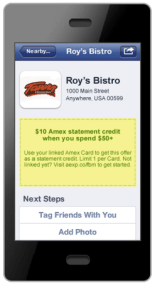
AMEX facebook

This morning American Express is launching a new deals platform in partnership with Facebook that should make big waves in the payments and offers space.
Winners: Facebook, American Express, small businesses
Losers: Groupon, LivingSocial, Google, foursquare, VISA, MasterCard

With the new platform, merchants will be able to target deals at American Express cardholders on the Facebook platform. Initial launch partners include H&M, Sports Authority, Dunkin’ Donuts, Sheraton, Westin, Travelocity and Celebrity Cruises. Although the launch focus is on big national brands, the platform is self-serve and well suited to the needs of small business. This presents a big and credible threat to Groupon, LivingSocial, Google Offers and other daily deal providers.
The platform covers both one-time and loyalty offers. Some examples of the offers that could be presented:
  • Spend $30 and get a $10 statement credit.
  • Spend $50 and get 10% back.
  • Visit 3 times, spend $50 each time and get a $10 statement credit.
The offers work much like the recent foursquare and American Express deal: you link an American Express card to your Facebook account, select an offer to load it on your card and then pay using your AMEX. If you meet the offer criteria, you get the discount as a statement credit. This offers a significant benefit to retailers: no staff training required. Training has long been the bane of promotions and is often executed poorly. I recently spent 30 minutes at Radio Shack trying to redeem a foursquare offer. That’s a terrible experience for the consumer and the merchant.

For merchants, it also provides additional benefits over Groupon, Google Offers and LivingSocial. Ironically, the daily deals model is currently about as targeted as media that were available when AMEX was founded more than 160 years ago. For the most part, it’s at the region level (although it is moving towards a more geographically targeted approach). AMEX can do much better. This allows merchants to reach just the customers who are within their trade area, instead of offering deep discounts to deal seekers who come from 45 miles away and would never return at full price.
Merchants also benefit from analytics that AMEX can provide. Because it processes all of the transactions through its network, it can report on that data. AMEX captures important metrics like total spend. Tracking beyond initial sales of offers is another significant area where Groupon, Google Offers, and LivingSocial fall down.

In the future, I would look for AMEX to integrate this platform with transaction history data and its popular Membership Rewards program. With transaction history, merchants could better target cardmembers. Instead of sending out an offer to anyone in the city who wants a cheap massage, the offer could be sent to people within 5 miles who have shown a history of buying spa services and spend a lot of money each year. Membership Rewards integration could allow consumers to redeem points at any merchant on the American Express network, similar to the way in which consumers can redeem points for Amazon purchases.

The AMEX platform illustrates a big difference in business model. Groupon and other daily deal providers need to make their money on a one time deal with the merchant. As a result, in my opinion they’re doing a lot of deals that are bad for businesses. AMEX is forgoing that upfront revenue to build a long term relationship with the merchant that pays off over time. AMEX wins in three ways: driving traffic onto its network for existing merchants over VISA and Mastercard, providing a clear differentiator to encourage new merchant accounts and encouraging new cardholders.  And the biggest difference of all: AmEx doesn’t take a 50 percent cut of each deal like Groupon does.  It takes zero percent of the actual deal, and makes money instead through normal payment transaction fees.
The biggest question in my mind is how much marketing effort AMEX and Facebook will put behind this. The platform itself has the potential to become a serious Groupon competitor. But it needs marketing muscle behind it.  If they don’t, it’s just another product announcement by a big company.

The AMEX/Facebook announcement also reinforces the folly that is Google’s bet on NFC. For some reason, Google is enamored with that technology. NFC is a solution in need of a problem. In the best case scenario, that investment will pay off in 3 to 5 years for Google. AMEX and Facebook are launching a product that works today.

The other big loser in this is foursquare. The announcement is pretty much the same thing that foursquare did with American Express. Except that in this case, it has the potential to reach more than 750 million unique users.

Source: Techcrunch

Healthcare Disruption: Pharma 3.0 Will Drive Shift from Life Science to HealthTech Investing (Part I of III)

Pharma - Pill Editor’s note: This guest post was written by Dave Chase, the CEO of Avado.com, a health technology company that was a TechCrunch Disrupt finalist. Previously he was a management consultant for Accenture’s healthcare practice and was the founder of Microsoft’s Health business. You can follow him on Twitter @chasedave.
Healthcare’s hyperinflation is driving the transformation of how care gets reimbursed resulting in a massive disruption in healthcare. For example, pharma companies will succeed or fail based not on how much drug they sell, but on how well their market offerings improve outcomes.
As the largest spenders on R&D in healthcare, massive changes in the way pharmaceutical companies operate are going to have a profound effect on health technology while letting pharma adapt to marketplace changes. It is creating opportunity for startup businesses that heretofore have been stymied when trying to make inroads into healthcare.

In the past, I have frequently said that healthcare is where tech startups go to die. A combination of factors ranging from risk aversion to entrenched legacy vendors exerting account control to health IT not being viewed as a source of competitive advantage for healthcare providers has made it difficult for promising new companies to make a dent. In this three-part series, I will lay out the most important dynamics transforming the opportunity for health technology startups.

In Part I, I will highlight how “Pharma 3.0” will drive a shift from traditional Life Science to HealthTech investing. In Part II, I will outline how healthcare providers will use HealthTech to differentiate and produce better outcomes. I’ll wrap up the series laying out how many healthcare organizations are on a path to repeat mistakes the newspaper industry made beginning in the mid-90’s. There are remarkable parallels that both spell peril for the incumbent healthcare providers if they repeat the newspaper companies’ mistakes and create massive new opportunities such as those I outlined earlier in pieces about The Most Important Organization in Silicon Valley No One Has Heard About and Hotwire for Surgery.


Pharma 3.0 Will Drive Shift from Life Science to HealthTech Investing
E&Y has produced industry reports for the Pharmaceutical industry that provide a comprehensive look at pharma’s history to outline its present condition. E&Y interviewed scores of innovators and senior executives to outline out a vision for what they call “Pharma 3.0.”
The following is an excerpt from their nearly 100 page report entitled “Progressions – Building Pharma 3.0” (read the full report here):
    The Progressions report identifies several industry trends driving nontraditional companies into the sector, including health reform, health IT, comparative effectiveness, and the rising confidence in consumer power. These factors and others are prompting pharmaceutical companies to broaden their focus from producing new medicines to delivering “healthy outcomes” – a shift that will be driven through creative partnerships and business model innovation.The Progressions report describes the rapid transition from the industry’s long-standing vertically integrated blockbuster-driven model, defined in the study as pharma 1.0, to today’s pharma 2.0 business model. Under this business model, companies have adopted a number of changes to improve productivity and financial performance, from pursuing more targeted therapies, broadening their portfolio of products and capabilities, to establishing more independent and flexible R&D units, to boosting partnerships with biotech firms, and universities and outsourcing many non-core functions. The report finds that even as pharmaceutical companies continue to implement strategies to prosper in pharma 2.0, these efforts may be overtaken by a pharma 3.0 “ecosystem” comprised of established industry members, nontraditional companies and an increasingly informed data-empowered consumer.
During my years working in health systems and hospitals, I rarely crossed paths with the pharma industry even though we were ostensibly serving the same organization. The only time I saw pharma reps was noticing well-dressed folks in the cafeteria that were clearly the pharma reps. My time was spent in the IT and Patient Accounting departments where much of Health IT was relegated.

Whereas Health IT was viewed as a cost item to be minimized, pharma and Medical Device products represented revenue generation and differentiation opportunities for healthcare providers.
In the flawed fee-for-service model that has driven healthcare’s hyperinflation, financial rewards incentivized activity (order a test, prescribe a drug, do a procedure, etc.) rather than positive health outcomes. For example, there are 60MM CT Scans done per year in the U.S. despite the fact that there isn’t a radiologist in the world who believes anywhere near that volume is required. Nonetheless, we incur that high cost and excess radiation in the fee-for-service that is the underpinning of the legacy reimbursement model. Fortunately, there’s a sea change to change reimbursement to reward positive health outcomes over mere activity. In addition, electronic medical records are helping reduce duplicate tests.

Based on my past (non)experience with pharma, it has been remarkable the number of pharma companies that are now proactively reaching out to software companies who can help them enter with new services focused on outcomes that have little or nothing to do with what I would traditionally associate with pharma. Their strategies are varied and dynamic but they aren’t sitting on their hands. For example, one shared how they recently entered into a 10-year agreement to be responsible for the end-to-end health of a population of individuals with a particular disease. As I will touch on in the 3rd part of the series, this will have a profound effect on the competitive landscape for traditional health providers. Not many healthcare providers are prepared for this type of competitor.

Like it or not, healthcare is like most arenas – revenue (aka reimbursement) drives behavior. pharma has been extremely adept at maximizing revenue in the fee-for-service environment. As one pharma exec said to me, “We have spent billions on developing and marketing our product but $0 on ensuring it is properly used.”

As pharma companies strive to be a “health outcomes” industry, the focus on outcomes will radically alter their behavior. They recognize the competitive threat. As the E&Y report stated, “Pharma companies have expanded the number of pharma 3.0 initiatives by 78% since 2010. Yet non-traditional players have invested even more in Pharma 3.0.” The sense of urgency with the pharma organizations I’ve met with is remarkable.

To date, IT investment in healthcare has been mostly limited to the administrative/reimbursement facets of healthcare (e.g., claims processing). The primary exception is the software that has been embedded into medical devices with little or no ability for the clinician to interact with the device. There’s a contrast with where money is actually spent in healthcare – i.e., healthcare delivery versus therapeutics as outlined in a piece by angel investor and life science veteran Don Ross in his piece “Investor: Health tech is the next big opportunity”.
How big is the healthtech opportunity? Data from the Centers for Medicare & Medicaid Services (CMS) show that the U.S. spent $2.5 trillion on health care in 2009. Of this, 84 percent was spent on healthcare delivery, which includes costs associated with clinicians and insurance companies. In contrast, only 16 percent was spent on therapeutics, including medical devices and drugs. Although venture investors traditionally have put their money into therapeutics rather than delivery, the balance is shifting.
As Pharma companies recast themselves as “health outcomes” companies in response to anticipated reimbursement shifts, one can expect that venture capitalists and Pharma/Biotech will shift their investment focus from almost exclusively Life Sciences to integrated approach with Health Tech and an outcomes. Areas such as decision support, care coordination, patient engagement, etc. become paramount if one is going to address outcomes versus simply encouraging more activities that the legacy reimbursement model have incentivized.

Increasingly the very survival of the pharmaceutical industry is predicated on creative alliances with nontraditional players such as IT companies. No longer will healthcare be where tech companies go to die for the startups with transformative products that may have languished in the past. The very survival of one of the most profitable industries in the world depends on it.

Source: Techcrunch

jeudi 21 juillet 2011

Guide de mise en œuvre du contrat de performance énergétique en logement social


En juin 2009, ICF s’est lancé dans l’expérimentation des contrats de performance énergétique, avec le double objectif de garantir la performance énergétique des logements et de financer la rénovation énergétique à travers le tiers investissement.

Un projet pilote a été lancé sur un site de 64 logements sociaux propriété d’ICF Nord-Est à Schiltigheim
(Bas-Rhin), en collaboration avec la direction du Patrimoine et l’agence ICF Alsace d’ICF Nord-Est. Cette expérimentation a été rendue possible par le soutien apportée par le programme européen Intelligent Energy Europe dans le cadre du projet FRESH, et parl’ADEME. ICF a été accompagné par une équipe d’assistance à maîtrise d’ouvrage composée d’Azan Avocats et Best Energies, ainsi qu’ICE pour la partie financière.
Ce guide est destiné à ceux qui, bailleurs ou entreprises, souhaiteraient mettre en oeuvre des CPE dans le
logement social.

Télécharger le guide CPE