Affichage des articles dont le libellé est Déchets et Recyclage. Afficher tous les articles

jeudi 30 août 2012

VC Perspective: Cleantech Startups Turn Garbage Into Gold


It’s not trash, it’s reverse logistics.
VC Perspective: Cleantech Startups Turn Garbage Into Gold

The average American generates 4.6 pounds of garbage every day, making the U.S. one of the biggest throwaway societies on the planet. E-waste, including cell phones, TVs, and computers, is a huge part of the problem. In 2009, this country generated 3,190,000 tons of e-waste, according to the Environmental Protection Agency. The vast majority of that e-waste (82.3 percent) ended up in landfills and incinerators, with only 17.7 percent going to recyclers.
 
That’s a dirty shame. But it’s a golden opportunity for startups that can find a solution. That’s why our venture capital firm, Claremont Creek Ventures, is actively looking for investments in the waste management space. In particular, we like companies that can profit by preventing consumers from placing their unwanted items in the garbage.
 
They say that one man’s trash is another man’s treasure. Except we don’t call it trash, we call it reverse logistics.
The idea is that instead of throwing away a product, like an old cell phone, consumers move it through a reverse supply chain, so it ultimately ends up in the hands of people who can reutilize the product. The trick to this approach being successful is getting consumers directly involved in the reverse logistics process.
 
A number of innovative startups are accomplishing this business strategy by offering cash for trash. Specifically, a company called EcoATM, which we invested in, is currently rolling out ATM-like kiosks in shopping malls throughout the nation. Consumers drop their old or unwanted cell phones into the dispenser, and instantaneously receive anywhere from several dollars to several hundred dollars in exchange. [Editor's note: EcoATM raised $14.4 million from Coinstar, Claremont Creek Ventures, and Silicon Valley Bank last year.]
 
These days, even big-box retailers are hiring third-party specialists to handle their reverse logistics. When you return your flat panel TV to Best Buy, for instance, they don’t simply box it up and ship it back to the manufacturer. They work with a reverse-logistics specialist that helps them find buyers for broken or defective products that would otherwise go straight to landfill.
 
Though concrete numbers are hard to come by, the worldwide market for reverse cell phone recycling is approximately $5 billion annually. The market gets even bigger if you start to add other electronic devices like tablet computers. Overall, it’s a huge market that has been relatively underpenetrated. Until recently, the market was left in the hands of small mom-and-pop recycling shops. But competition is on the rise, and a number of new venture-backed startups are looking to clean up in the market.
 
We see the reverse logistics space becoming even bigger as consumers play a more active role and get rewarded for their efforts. As a firm, we are looking at opportunities that expand the market further into areas like batteries and tablets. After all, reverse logistics is the ultimate win-win. Consumers win, companies win, and so does the planet.
***
Randy Hawks is Co-Founder and Managing Director of Claremont Creek Ventures.
Source : Greentech Media

jeudi 23 août 2012

Waste Management bets on turning trash into sugars


Finding new and profitable ways to recycle the trash it collects has guided the investment strategy of Waste Management, which recently put money into a startup that can turn some of the garbage into sugars for making plastic and other products.
Renmatix sugar
Waste Management has been a particularly active venture capital investor in the trash-to-energy space, and that focus has prompted it to invest in Renmatix, which turns biomass, such as agricultural wastes, into sugars for making fuels and other chemicals.
Renmatix increased its most recent round of investment from $50 million to $75 million and now counts the trash hauling giant as both an investor and a research and development partner, reported VentureWire Wednesday. Waste Management wants to use Renmatix’s technology to convert trash into sugars to replace petroleum for making plastics and other products.
Pennsylvania-based Renmatix announced the $50 million round in January this year and noted that German chemical giant BASF put $30 million into that round. Kleiner Perkins Caufield & Byers also is an investor.
Sugar is a key ingredient for biofuels and other chemical products. Its market potential has attracted more investors in recent years mainly because the government is spending billions of dollars to build a market for alternative fuels. Early on, many biofuel producers had to figure out their own processes for breaking down the tough cell walls of plants and other biomass to make cellulosic sugars and then converting the sugars into fuels.
In fact, there were hardly any companies that focused only on making only cellulosic sugars back in 2008, when an investment banker told me thenthat producing those sugars alone could be a great opportunity for entrepreneurs and investors. By the way, these sugars aren’t the same stuff that sweetens coffee or powder donuts.
Other companies in the cellulosic sugar market include Virdia, which announced a $20 millionventure capital investment from Khosla Ventures and others earlier this year and a package of $75 million in loans and up to $155 million in tax breaks from Mississippi to build a processing plant there.
Renmatix’s technology uses “supercritical hydrolysis” to produce sugars, a process the company says is cheaper and faster than some of the other technologies. The company has been running a demonstration plant in Georgia.
For Waste Management, Renmatix becomes one of a now long list of companies that it backs (check out our post about Waste Management’s investment strategy) so that it could find new and profitable uses for the trash it collects.

Source : GigaOM

mardi 15 mai 2012

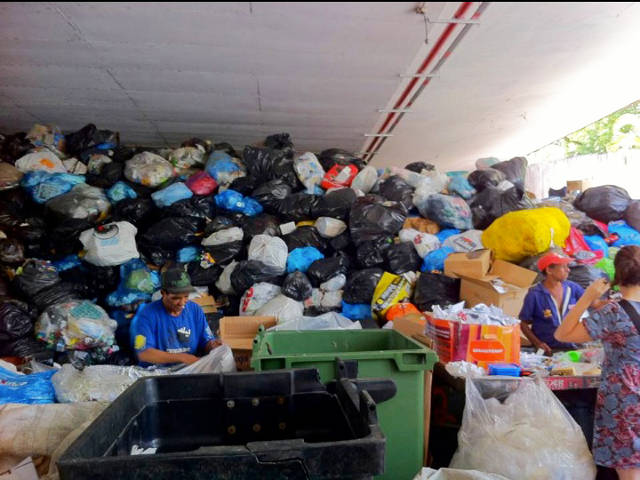
New Tech Lets An Army Of Informal Recyclers Collect Brazilian Waste


When it comes to taking out the trash, high technology can transform the lowliest of chores.
For decades, an informal recycling cooperative in Brazil has collected tons of recyclable material, which it sells back to heavy industry each day for reuse. The system, however, is plagued by inefficiencies: routes are haphazard, coordination is weak, and knowledge is easily lost when individuals leave the cooperatives.
Brazil is now trying to turn this army of informal recyclers into a crack recycling operation capable of collecting and selling a city’s recyclables without central coordination. Researchers at the University of São Paulo have teamed up with the Massachusetts Institute of Technology to optimize recycling routes, schedule waste pickups, and transform an overlooked sector of the economy into the next investment opportunity. To do it, they are attaching tracking sensors to carts and trucks, analyzing the data, building dispatching and scheduling applications for the web, and then mapping it all to city grids.


The project, known as Forage Tracking, does not deploy revolutionary software, or sensors. It is just a clever application of existing technology to solve social challenges.
"We are using real-time technology to make waste management more participatory and effective," says Dietmar Offenhuber, a researcher at the MIT’s SENSEable City Lab in the Brazilian publication Institute Science Today. "The idea is to help the informal recycler cooperatives with cheap technologies to document their knowledge and improve their operations."
Ultimately, the program will enlist private corporations, government agencies, and thousands of informal workers in a single and (potentially) efficient waste collection system. In the future, Brazilians should be able to schedule waste pickups on their smartphones. Those pickups wouldn’t be made by the city, but by informal workers.
But it’s also looking like a sign of things to come. Economic growth in the developing world, if it will lead to more than just slightly less stratified inequality, needs to lift up the poor and middle class, as well as the rich. That requires more than corporations and the state, argues Robert Neuwirth in his new book Stealth of Nations. It demands cooperation between the formal sector and the innovative but informal economy of the street (as we reported on earlier this year).
Brazil--by bringing recycling cooperatives into its solid waste system through Forage Tracker and new laws--is taking a small step in that direction.
Source : FastCoexist

mercredi 2 mai 2012

EcoATM raises $17M for nationwide rollout of e-waste kiosks


Will the supermarket kiosk craze that helps you cash in coins, rent DVDs and recycle water bottles lead to a boom in gadget and cell phone recycling? A startup called ecoATM hopes so, and its idea to build electronics recycling kiosks nationwide has enabled it to raise a series B round of funding of about $17 million, the company said Tuesday.
The San Diego startup puts kiosks in shopping malls and other retail spaces — particularly in locations near stores selling consumer electronics — that dispense cash, gift cards or coupons for mobile gadgets. The company has lined up buyers who promise to pay for the gadgets it collects, so when a consumer uses the kiosk to sell her phone, ecoATM can search for the best price from among its network of buyers and pass on part of that revenue to the consumer.
The company raised $14.4 million only over a year ago, and investors from that round, including Claremont Creek Ventures and Coinstar, also put money into the new round. New investors include PI Holdings, Moore Venture Partners and Koh Boon Hwee, who ecoATM describes as a “Singapore billionaire” (he was former chairman of Singapore Airlines and Singapore Telecom and worked at Hewlett-Packard).
EcoATM already has kiosks operating in about 50 locations in California and a smattering more in other states such as Kansas, Nebraska and Washington, according to the company’s website. The one at the Nebraska Furniture Mart was the company’s first installation and put in service in the fall of 2009. The company used to have a more ambitious plan of installing 200 kiosks by the end of 2010.
The new funding will enable the company to carry out a broader, national rollout, said ecoATM’s CEO, Tom Tullie, in a statement.
E-waste recycling isn’t a new idea, but making it convenient could help it become a habit. Even though people know recycling is a good thing, they may not go out of their way to hunt for recycling centers and drive there or ship their gadgets. Some recycling centers take old gadgets but don’t pay for them. So getting money or other goodies in return could be an attractive incentive.
The Consumers Electronics Association estimated back in 2008 that each American household owned 24 electronic devices. The head of the federal Environmental Protection Agency, Lisa Jackson, has called on electronic companies to think about how their gadgets could be recycled while they are designing products. In 2005, the U.S. generated 2 million tons of e-waste and only about 350,000 tons of them were recycled, the EPA said. The rest just ended up in landfills here and abroad.
Source : GigaOM