Affichage des articles dont le libellé est bitcoin. Afficher tous les articles

lundi 6 janvier 2014

Why I Lost Faith In Bitcoin As A Money Transfer Protocol

As 2013 came to an end, many reflected on last year’s biggest tech news — and Bitcoin was a serious contender. But the main question remains: why are people interested in Bitcoin?

This whole debate reappeared when Charlie Stross stated that “Bitcoin looks like it was designed as a weapon intended to damage central banking and money issuing banks, with a Libertarian political agenda in mind — to damage states ability to collect tax and monitor their citizens financial transactions.” Paul Krugman then quoted his post, neither denying nor approving this thought.
But Chris Dixon (and Fred Wilson in the comment section) reiterated their strong interest in Bitcoin while sharing that they are both Democrats.
If major Bitcoin enthusiasts don’t have any political agenda in mind, then what is the future of Bitcoin? At its heart, Bitcoin is a cryptocurrency that doesn’t rely on any central bank. Bitcoins are just a chain of characters defined by algorithmic rules, and transactions are handled by the network of miners.
Yet, in a month’s time, the value of a bitcoin went from $200 to more than $1,000 on all the exchanges. In other words, it is as volatile as it can get. Right now, there are only around 12 million of bitcoins in circulation, and many Bitcoin holders are recent converts that buy and sell every day. So how could you think about using bitcoins to pay the rent? You could simply hold your bitcoins and expect to triple your wallet value in a couple of weeks instead.
That’s why I believe Bitcoin isn’t the next world currency. Bitcoin’s true purpose is not what everyone originally expected — you won’t buy a pizza in bitcoins anytime soon. Moreover, Bitcoin won’t be able to remain an unregulated currency for long.
So Bitcoin’s true purpose lies somewhere else. As Bitcoin is a peer-to-peer payment network, you don’t need any banking institution to make large transfers. Bitcoin could become the first meta-currency that sits on top of traditional currencies, the common language between USD and EUR. That’s what Dixon finds interesting, Bitcoin is as much a money transfer protocol as a currency. And it has the potential of disrupting the traditional banking system.

Replacing Forex Transactions With Bitcoin

As I live in France and work for an American company, I thought I would be the perfect candidate for this particular use case. I tried to use Bitcoin to transfer a small amount of money between the U.S. and France. At first, I purchased bitcoins using Coinbaseand my U.S. bank account (a couple of dollars in fees). The process was very easy, but because I don’t meet the requirements to make instant purchases, I had to wait about a week before I could actually do anything with my bitcoins. Coinbase had to verify the transaction first.
While I take Coinbase as an example here, there aren’t many trustworthy and easy-to-use services to make Bitcoin transactions yet — and all services have flaws. People ask me all the time how they could buy bitcoins, and I don’t have a simple answer.
In that period of time, bitcoins went from about $850 a bitcoin to more than $1,000, then back to $700 — I only could sit back and enjoy the ride. Then, when I finally got my bitcoins, I transfered them to Bitstamp in a couple of hours (no fee) — it was flawless and a great example of the beauty of Bitcoin. Finally, I transfered my bitcoins to my French account ($1.24 fee to convert into EUR with a very good conversion rate). I had to wait a few days before getting my money because of the traditional banking system.
Overall, it was a painful experience, even more painful than using traditional foreign exchange services. But more importantly, I don’t see how I could trust Bitcoin as a money transfer protocol with such a high volatility. Fees were much lower, but it doesn’t matter if you don’t know how much money you will get on your bank account in the end.
A couple of weeks ago, Bitcoin’s value went from more than $1,100 to around $650 in a few hours, because of a new rule in China. You can’t use Bitcoin for serious amounts of money if there is a chance of losing 40 percent of your money overnight.
As long as Bitcoin remains a young and volatile currency, Bitcoin’s mechanisms will remain beautiful on paper. Using it for real world transactions would be crazy, and I think we are still a couple of years away from getting a stable Bitcoin that can be trusted. Until then, using Bitcoin will remain a wild ride — it’s definitely fun, but don’t take Bitcoin seriously just yet.
Source : Techcrunch

mercredi 27 novembre 2013

Is Bitcoin about to change the world?

If you want to buy drugs or guns anonymously online, virtual currency Bitcoin is better than hard cash. Canny speculators have been hoarding it like digital gold. Now the world's leading bankers are even talking about as a rival for real money. How does it work, where can you get it and is it the future.
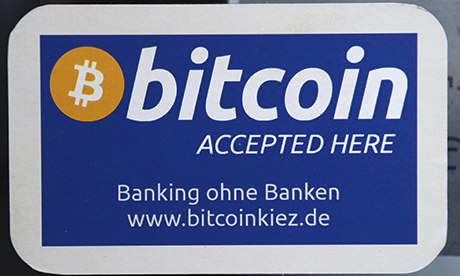
A sign above a bar in Germany.
A sign above a bar in Germany. Photograph: Alamy
The past weeks have seen a surprising meeting of minds between chairman of the US Federal Reserve Ben Bernanke, the Bank of England, the Olympic-rowing and Zuckerberg-bothering Winklevoss twins, and the US Department of Homeland Security. The connection? All have decided it's time to take Bitcoin seriously.
Until now, what pundits called in a rolling-eye fashion "the new peer-to-peer cryptocurrency" had been seen just as a digital form of gold, with all the associated speculation, stake-claiming and even "mining"; perfect for the digital wild west of the internet, but no use for real transactions.
Bitcoins are mined by computers solving fiendishly hard mathematical problems. The "coin" doesn't exist physically: it is a virtual currency that exists only as a computer file. No one computer controls the currency. A network keeps track of all transactions made using Bitcoins but it doesn't know what they were used for – just the ID of the computer "wallet" they move from and to.
Right now the currency is tricky to use, both in terms of the technological nous required to actually acquire Bitcoins, and finding somewhere to spend them. To get them, you have to first set up a wallet, probably online at a site such as Blockchain.info, and then pay someone hard currency to get them to transfer the coins into that wallet.
A Bitcoin payment address is a short string of random characters, and if used carefully, it's possible to make transactions anonymously. That's what made it the currency of choice for sites such as the Silk Road and Black Market Reloaded, which let users buy drugs anonymously over the internet. It also makes it very hard to tax transactions, despite the best efforts of countries such as Germany, which in August declared that Bitcoin was "private money" in which transactions should be taxed as normal.
It doesn't have all the advantages of cash, though the fact you can't forge it is a definite plus: Bitcoin is "peer-to-peer" and every coin "spent" is authenticated with the network. Thus you can't spend the same coin in two different places. (But nor can you spend it without an internet connection.) You don't have to spend whole Bitcoins: each one can be split into 100m pieces (each known as a satoshi), and spent separately.
Although most people have now vaguely heard of Bitcoin, you're unlikely to find someone outside the tech community who really understands it in detail, let alone accepts it as payment. Nobody knows who invented it; its pseudonymous creator, Satoshi Nakamoto, hasn't come forward. He or she may not even be Japanese but certainly knows a lot about cryptography, economics and computing.
It was first presented in November 2008 in an academic paper shared with a cryptography mailing list. It caught the attention of that community but took years to take off as a niche transaction tool. The first Bitcoin boom and bust came in 2011, and signalled that it had caught the attention of enough people for real money to get involved – but also posed the question of whether it could ever be more than a novelty.
The algorithm for mining Bitcoins means the number in circulation will never exceed 21m and this limit will be reached in around 2140. Already 57% of all Bitcoins have been created; by 2017, 75% will have been. If you tried to create a Bitcoin in 2141, every other computer on the network would reject it as fake because it would not have been made according to the rules of currency.
The number of companies taking Bitcoin payments is increasing from a small base, and a few payment processors such as Atlanta-based Bitpay are making real money from the currency. But it's difficult to get accurate numbers on conventional transactions, and it still seems that the most popular uses of Bitcoins are buying drugs in the shadier parts of the internet, as people did on the Silk Road website, and buying the currency in the hope that in a few weeks' time you will be able to sell it at a profit.
This is remarkable because there's no fundamental reason why Bitcoin should have any value at all. The only reason people are willing to pay money for the currency is because other people are willing to as well. (Try not to think about it too hard.) Now, though, sensible economists are saying that Bitcoin might become part of our future economy. That's quite a shift from October last year, when the European Central Bank said that Bitcoin was "characteristic of a Ponzi [pyramid] scheme". This month, the Chicago Federal Reserve commented that the currency was "a remarkable conceptual and technical achievement, which may well be used by existing financial institutions (which could issue their own bitcoins) or even by governments themselves".
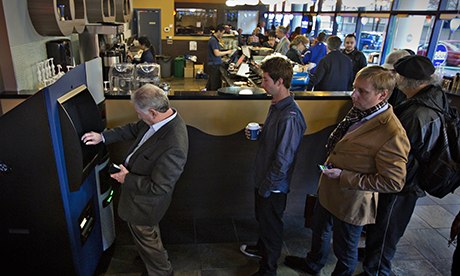
The First Bitcoin ATM, in Canada.The First Bitcoin ATM, in Canada. Photograph: REUTERS
It might not sound thrilling. But for a central banker, that's like yelling "BITCOIIINNNN!" from the rooftops. And Bernanke, in a carefully dull letter to the US Senate committee on Homeland Security, said that when it came to virtual currencies (read: Bitcoin), the US Federal Reserve had "ongoing initiatives" to "identify additional areas of … concern that require heightened attention by the banking organisations we supervise".
In other words, Bernanke is ready to make Bitcoin part of US currency regulation – the key step towards legitimacy.
Most reporting about Bitcoin until now has been of its extraordinary price ramp – from a low of $1 in 2011 to more than $900 earlier this month. That massive increase has sparked a classic speculative rush, with more and more people hoping to get a piece of the pie by buying and then selling Bitcoins. Others are investing thousands of pounds in custom "mining rigs", computers specially built to solve the mathematical problems necessary to confirm a Bitcoin transaction.
But bubbles can burst: in 2011 it went from $33 to $1. The day after hitting that $900 high, Bitcoin's value halved on MtGox, the biggest exchange. Then it rose again.
Speculative bubbles happen everywhere, though, from stock markets to Beanie Babies. All that's needed is enough people who think that they are the smart money, and that everyone else is sufficiently stupid to buy from them. But the Bitcoin bubbles tell us as much about the usefulness of the currency itself as the tulip mania of 17th century Holland did about flower-arranging.
History does provide some lessons. While the Dutch were selling single tulip bulbs for 10 times a craftsman's annual income, the British were panicking about their own economic crisis. The silver coinage that had been the basis of the national economy for centuries was rapidly becoming unfit for purpose: it was constrained in supply and too easy to forge. The economy was taking on the features of a modern capitalist state, and the currency simply couldn't catch up.
Describing the problem Britain faced then, David Birch, a consultant specialising in electronic transactions, says: "We had a problem in matching the nature of the economy to the nature of the money we used." Birch has been talking about electronic money for over two decades and is convinced that we find ourselves on the edge of the same shift that occurred 400 years ago.
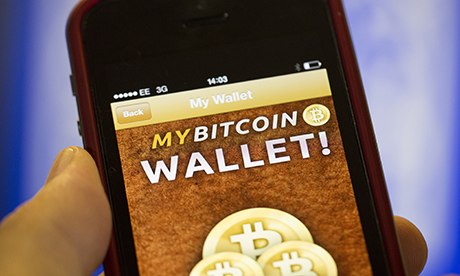
A Bitcoin wallet on a smartphone.A Bitcoin wallet on a smartphone. Photograph: Bloomberg via Getty Images
The cause of that shift is the internet, because even though you might want to, you can't use cash – untraceable, no-fee-charged cash – online. Existing payment systems such as PayPal and credit cards demand a cut. So for individuals looking for a digital equivalent of cash – no middleman, quick, easy – Bitcoin looks pretty good.
In 1613, as people looked for a replacement for silver, Birch says, "we might have been saying 'the idea of tulip bulbs as an asset class looks pretty good, but this central bank nonsense will never catch on.' We knew we needed a change, but we couldn't tell which made sense." Back then, the currency crisis was solved with the introduction first of Isaac Newton's Royal Mint ("official" silver and gold) and later with the creation of the Bank of England ("official" paper money that could in theory be swapped for official silver or gold).
And now? Bitcoin offers unprecedented flexibility compared with what has gone before. "Some people in the mid-90s asked: 'Why do we need the web when we have AOL and CompuServe?'" says Mike Hearn, who works on the programs that underpin Bitcoin. "And so now people ask the same of Bitcoin. The web came to dominate because it was flexible and open, so anyone could take part, innovate and build interesting applications like YouTube, Facebook or Wikipedia, none of which would have ever happened on the AOL platform. I think the same will be true of Bitcoin."
For a small (but vocal) group in the US, Bitcoin represents the next best alternative to the gold standard, the 19th-century conception that money ought to be backed by precious metals rather than government printing presses and promises. This love of "hard money" is baked into Bitcoin itself, and is the reason why the owners who set computers to do the maths required to make the currency work are known as "miners", and is why the total supply of Bitcoin is capped.
And for Tyler and Cameron Winklevoss, the twins who sued Mark Zuckerberg (claiming he stole their idea for Facebook; the case was settled out of court), it's a handy vehicle for speculation. The two of them are setting up the "Winklevoss Bitcoin Trust", letting conventional investors gamble on the price of the currency.
Some of the hurdles left between Bitcoin and widespread adoption can be fixed. But until and unless Bitcoin develops a fully fledged banking system, some things that we take for granted with conventional money won't work.
Others are intrinsic to the currency. At some point in the early 22nd century, the last Bitcoin will be generated. Long before that, the creation of new coins will have dropped to near-zero. And through the next 100 or so years, it will follow an economic path laid out by "Nakomoto" in 2009 – a path that rejects the consensus view of modern economics that management by a central bank is beneficial. For some, that means Bitcoin can never achieve ubiquity. "Economies perform better when they have managed monetary policies," the Bank of England's chief cashier, Chris Salmon, said at an event to discuss Bitcoin last week. "As a result, it will never be more than an alternative [to state-backed money]." To macroeconomists, Bitcoin isn't scary because it enables crime, or eases tax dodging. It's scary because a world where it's used for all transactions is one where the ability of a central bank to guide the economy is destroyed, by design.
For Bitcoin developer Hearn, that's not a concern. "Bitcoin's monetary policy would only be relevant if it were to be adopted by an entire economy, which isn't going to happen any time soon."
Already, alternatives based on Bitcoin have sprung up: for instance, Litecoin speeds up transaction processing and Freicoin introduces measures to stop people hoarding their money, but both are essentially the same technology, "forked" from the original. There's even nothing to stop a nation state declaring its own version of Bitcoin as legal tender.
So even if the currency of the future looks like Bitcoin, it might end up being a distant successor of the pioneer. "Is the technology of Bitcoin a window into the future?" asks Birch. "Yes. Is Bitcoin itself? No."
Source : The Guardian

jeudi 3 octobre 2013

Is Bitcoin The New Euro?


Bitcoin Hero

Originally dubbed ‘the single currency,’ the euro has been around for a decade and was in the works for another decade before it entered circulation in 2002. At the time, it was something revolutionary, a bold initiative that could have failed multiple times along the way.
Yet, it hasn’t become the universal currency and the European Central Bank is now testing the boundaries of the euro. Bitcoin could be the surprising and beautifully designed world cryptocurrency that will take the euro’s dreams to the next level. We will discuss this at Disrupt Europe later this month.

Bitcoin Is The True Single Currency

There are a few reasons why the euro will always stay limited in scope. As one can read in 1992′s Maastricht Treaty (the Treaty on the European Union), the euro is “a single and stable currency,” nothing fancier than that. In other words, its creation mechanisms are similar to those of any other modern currency. There is a central bank, there are interest rates.
Moreover, stating that the euro is a “stable currency” is already very political. It refers to Germany’s old traumatism of hyperinflation — at all times, the euro has to avoid inflation. This is probably the most important way the European Central Bank differs from the U.S. Federal Reserve — price stability comes first in Europe. Even though politics and monetary policies are supposed to be separate, this rule proves that it’s not the case.
These days, as everyone can see with Greece’s economic troubles, the only adjustment variable is jobs. When a eurozone country is no longer as competitive as its neighbors, prices stay the same. Consumption falls and the unemployment rate rises. To fight unemployment, many have to accept pay cuts. European governments would rather create a giant help fund than endanger the euro’s stability.
For all these reasons, the euro is just another traditional currency used in a few countries. It shares all the same weak points.

By definition, Bitcoin is apolitical. It is its greatest strength and weakness.

Bitcoin is nothing like that. It was born on the idea that nobody could regulate it. Instead of having a central bank, Bitcoins are just a chain of characters defined by algorithmic rules. Anybody can try to find new Bitcoins and anybody can verify if it is indeed a real Bitcoin or not. All of this is handled by open-source Bitcoin applications and a few proprietary variants.
By definition, Bitcoin is apolitical. It is its greatest strength and weakness. As long as you have access to the right technological tools (a computer, internet access…), you can make transactions in Bitcoins. When the economy thrives or stagnates, Bitcoin will have its own separate trend. As the great crash of April 2013 shows us, it is as volatile as it can get. While it is still early to see significant mainstream Bitcoin use cases, the story of this new currency is a fascinating one.
And we’re excited to reveal that we will hold a panel at Disrupt Europe in late October in Berlin with Shakil Khan (CoinDesk) Pamir Gelenbe (st-ART/Bitcoin London) and Nejc Kodric (Bitstamp). Khan is an expert when it comes to Bitcoin news, while Gelenbe has successfully organized the Bitcoin London conference. Finally, Kodric is the co-founder and CEO of the largest European Bitcoin exchange, and the second one in the world behind Mt. Gox. They will all have interesting thoughts to share on the future of Bitcoin, its caveats and more.

Bitcoin’s Weaknesses

What happens when your Bitcoin wallet value in euros falls by 50 percent in a day? If your company pays you in Bitcoins, it sounds like bad news. The future of Bitcoin as a mainstream currency is unclear. Make no mistake, the euro will remain the dominant currency in eurozone for now.
To avoid disastrous news like that, many countries, including the U.S. and Germany, are trying to regulate Bitcoins. If you really want to use Bitcoins, you’ll have to prove that you’re ready to handle the financial risks.
Back in August, a federal judge in Texas has declared that Bitcoin was a currency and should be regulated just like euros or U.S. dollars. This decision threatened Bitcoin’s utopian concept.
“The only limitation of Bitcoin is that it is limited to those places that accept it as currency,” wrote Judge Amos Mazzant. “However, it can also be exchanged for conventional currencies, such as the U.S. dollar, Euro, Yen, and Yuan. Therefore, Bitcoin is a currency or form of money,” the judge continued.

Bitcoin won’t be able to remain an unregulated currency for long

Similarly, New York’s financial services stated that Bitcoin companies should respect the current financial regulatory guidelines. Making sure that these companies are all on the same page when they operate in the U.S. is necessary to protect customers. Moreover, New York’s top banking regulator wants to write a new set of rules to decrease illegal Bitcoin activities.
“We have also seen instances where the cloak of anonymity provided by virtual currencies has helped support dangerous criminal activity, such as drug smuggling, money laundering, gun running, and child pornography,” Financial Services superintendent Benjamin M. Lawsky said in a statement. ”Taking steps to root out illegal activity is both a legal and business imperative for virtual currency firms,” he added.
Finally, following a parliamentary inquiry, Germany stated that Bitcoin should be considered as “private money.” It has many implications, starting by paying sales tax (VAT). While the conclusions are simple, the execution is more complicated as Germany is a mere member of the eurozone. If Germany really wants to pursue this further, it will probably have to lobby European institutions to change the rules on a European level.
All these rulings prove one thing: Bitcoin won’t be able to remain an unregulated currency for long. It won’t work similarly in every country of the world. Soon, Bitcoin users and companies will have to find a way to avoid tax, and authorities have a say in what you are doing with your Bitcoins.
It is not necessarily a bad thing as using a totally unregulated currency is unsustainable for many industries and use cases. But Bitcoin’s true purpose is not what everyone originally expected.

Bitcoin Is The First Meta-Currency

The Bitcoin network is a peer-to-peer payment network, you don’t need any banking institution to make large transfers. Instead of replacing the euro, the cryptocurrency could become the first meta-currency, a new currency that sits on top of traditional currencies for very specific use cases.
With the euro, European Union member countries wanted to create a second world currency to compete with U.S. dollars. Having a dominant currency has many advantages. According to French historian Jacques Rueff, countries (such as the U.S.) who use a major currency can sustainably keep a negative balance of payments — he calls that the “deficit without tears.”

Bitcoin could become the first meta-currency that sits on top of traditional currencies

In many ways, the European Union was successful with the euro. While it hasn’t become the universal currency, no one can deny that the euro is a major world currency. But now that two different currencies matter on a global scale, economic agents need a tool that sits between U.S. dollars and euros. Currently, about 100 percent of foreign exchange transactions involve dollars (out of 200 percent because forex transactions involve two currencies) compared to 64 percent for euros.
Bitcoin can become the common language between USD and EUR. To use Bitcoins in Italy or Ecuador, you don’t have to pay any fees. Moreover, you can exchange some Bitcoins in dollars when you’re investing in Ecuador, or exchange some Bitcoins in euros when you’re investing in Italy. Bitcoin is a money transfer protocol as much as a currency. For now, this aspect is underused but could actually become Bitcoin’s most interesting future prospect.

Source : Techcrunch