Affichage des articles dont le libellé est internet of things. Afficher tous les articles

lundi 10 février 2014

What’s the best way to fund the internet of things?

money
photo: sushi♥ina
SUMMARY:
The IoT community is still debating which of three different funding models will best support development, with some favored by Europe and some by the US. Understanding these models is crucial to understanding where the technology is heading and what region will lead the way.
When it comes to smart cities and the internet of things, everyone asks, “Where is the money?” I have observed very dissimilar points of view on financing for the IoT in keynote topics in conferences and in discussions throughout the year, in particular at the recent Internet of Things Forum in Cambridge in the U.K., and the M2M & Internet of Things Global Summit in Washington D.C. It struck me that the ideas were as far apart as the venues themselves. It’s important to understand these different funding models, because they are driving the development of the IoT.
There is no easy answer to the funding question because the IoT market is still very fragmented. From our perspective of sensors and hardware, we see small pieces of revenue coming from many different verticals. I think of these as trial balloons, just validating the huge potential of the IoT and its power to be the next technology revolution. Even so, we see smart agriculture and smart cities as the verticals with the most traction right now. Differences in these two sectors shed light on the key question of funding the IoT. Will it be public or private?

The three primary funding models

Smart agriculture is privately funded in many cases, and the return on investment has to be obvious from the start. Smart cities have so many more stakeholders and the approach is not so clear-cut. There are many different ways to support their development, some coming from academia, communities, and industry.
1. Public money. In my view, had it not been for the economic crisis, public funding would have been the normal route. Right now European Union funds play an important role in allowing a number of connected smart cities pilots to really test the technology and accelerate the uptake of services. The existence of these European Commission funds makes the difference between what we see happening in Europe vs. the US market, allowing Europe to lead the way.
At Cambridge people thought of Europe as ahead of the U.S. in the IoT, whereas in Washington there were fears that a “go-with-grants” model is harmful because it is an unsustainable business model. The U.S. wants to see how Europe will maintain smart cities projects over time, and several critics point to the lack of a business model in flagship smart cities projects funded with EU funds. It’s true that these projects are usually led by academia, and business sustainability is not usually the focus. But don’t forget: the very first step is validating the technology.
2. Public/private partnership (PPP). In PPP, private companies invest and go on a cost-savings-share model with municipalities. It is a viable funding mechanism for smart cities, and in fact, the US has a history of finding capital for transportation and infrastructure projects this way. PPPs can create new forms of cooperation and resource sharing.
In this model, who would be the perfect private partner? Here, we stumble into a paradox in the nascent IoT market. Due to the similarity between IoT networks and telephony networks, operators should be the logical owners of IoT infrastructure as a new connectivity channel. However, the system integrators are the ones leading the way. This is because an operator needs to cover a whole country, or at least a circuit including major cities, and that requires a lot of investment. On the other hand, integrators can jump from project to project, testing the hottest verticals. But keep your eye on the bouncing ball, because this situation is evolving. Today operators are letting the integrators pay for their education.
3. Citizen participation. Community-led projects that apply the current trend of crowdfunding through platforms like Kickstarter are gaining momentum. I know of a number of civic projects that are spearheaded by citizen activists, such asAirQualityEgg, a device that measures air quality, or SafeCast’s network of individual airborne radiation sensors in Fukushima (Libelium was a partner in this project).
SafeCast's crowdsourced map of airborne radiation in Japan.
SafeCast’s crowdsourced map of airborne radiation in Japan.
This is such an interesting model, and I wonder if governments can incentivize citizens to acquire the sensors and build the systems themselves, perhaps by offering tax breaks or other benefits.
Investing the funds: hardware or services?
Once the money is raised, how will we spend it? In Cambridge, the prevailing view was that IoT money should be devoted to infrastructure. In Washington D.C. people were not so sure, because they believe in a model where services generate more money than hardware.
For the sake of argument, I like to compare the IoT to the railway age. There are many parallels, not only because both of these inventions are industrial revolutions with the ability to change everything. For a moment, try to imagine railway and train builders pitching to raise money. Would venture capitalists just tell them “Nah! We prefer to invest in companies that will be handling the ticketing system…?” Of course not! No services are possible, nor is any other type of future business, if we do not have the infrastructure in place.
Someday, it is true, hardware will be commoditized, and revenues will come from services associated to data, but if we are in the midst of raising a new market, that day is still really far away.
Alicia Asin is the co-founder and CEO of Libelium, a provider of open hardware for wireless sensor networks used in Smart Cities and Internet of Things projects.
Source : Gigaom

mercredi 29 janvier 2014

Google Is Making A Land Grab For The Internet Of Things


Before this past December, when Google acquired seven robotics companies back-to-back, the company’s ambitions in the “Internet of Things” space looked as detailed as a freshly started jigsaw puzzle.
But with its last three acquisitions — Boston Dynamics, Nest and DeepMind — it seems like Google is rapidly collecting the individual pieces to put together a “real life Internet,” a network of AI-driven robots and objects that could improve transportation, manufacturing and even day-to-day consumer life.
Google’s “real life Internet,” a business that reaches far beyond web search and online advertising, may look like a General Electric on the Internet of Things side, and an IBM on the software side — where artificial intelligence is at the core of products likeWatson.
At least that’s what it looks like right now, as the search giant is gobbling up almost every company that could fit into the puzzle, combining hardware, software, analytics, robotics and artificial intelligence into, well, something.

Google X, the company’s skunkworks unit that’s been developing driverless cars among several other sci-fi-esque projects, now seems to be leading Google’s hefty meatspace ambitions.
One obvious extrapolation from all these acquisitions is that Google will be in the business of data for a long time. Covering computers, tablets and now phones with Android and building applications like Maps to harvest information about its hundreds of millions of users, Google is now looking far beyond traditional computing devices. Acquiring Nest, which builds smart home devices, was one swift lunge in that direction.
How many more of these diversity acquisitions will we see before 2014 closes out?
Since last Christmas, Google has dropped well over $4 billion on buying seven roboticscompanies and Big Dog maker Boston Dynamicsenlisting Android guru Andy Rubin to figure out what do with them.  Internet of Things darling Nest, and AI company DeepMind will operate outside of the robotics division, according to Liz Gannes.
Google is betting its future on the fact that one day our cars, refrigerators, mobile phones, computers and home devices will communicate with each other, generating insights that can be converted into data. And that these newer channels will result in a massive advertising opportunity.
But what can Google accomplish that IBM and GE cannot?
IBM has invested $1 billion in its AI-driven Watson project, which is expected to bring $10 billion in revenue over the next few years. Facebook too, has set up an artificial intelligence team to understand emotions, and according to The Information and a tipster, was even in the race to acquire DeepMind (our tipster held the Facebook bid at $450 million).
And good old GE is putting all its might behind building software platforms that bridge the physical world of industrial machines with the Internet — a strategy and aim similar to Google’s but for the machine world.
So far, IBM has depended heavily (perhaps doggedly) on Watson for making its artificial intelligence push work. Since its launch around three years ago, IBM has been pushing aggressively to turn its “Jeopardy”-winning computer into a business where healthcare and telecom companies pay to use Watson in real life. But as a WSJ piece earlier this month pointed out, IBM has been struggling to make it work.
On the enterprise side, both IBM and GE are still far away from making any big impact in terms of revenues, despite having the experience of working with Fortune 500 companies for decades.
Watson’s biggest challenge today is solving real-life problems and living up to the “intelligence” part of the artificial intelligence equation.
When asked by the New York Times what he wanted to build at Google, Andy Rubin brought up the example of a windshield wiper that turned itself on when it rains. 
As humble as that sounds, Google ostensibly has a head start in terms of AI-practicality, with Google Now making strides in the proactive computing field. It also has a tremendous advantage in its treasure chest of user data, allowing it to predict and analyze patterns in behavior and needs more robustly than any competitor.
With one of the largest server architectures on the Internet, Google has the big computing power necessary for AI processing at its fingertips. It also has ancillary Google X efforts like Project Loon that could blanket areas in connectivity needed to power robotics.
A “real life Internet” may be closer than we think.
‘Her’ image via IMDB, Warner Bros. 
Source : Techcrunch

vendredi 20 décembre 2013

A Google Glass-style display add-on for motorbike helmets : Ride:HUD

The Internet of Things is gradually transforming households into smart spaces and we’ve even previously seen the same concept applied to vehicles, with models such as the Xkuty scooter enabling owners to take advantage of smartphone control. However, separate devices can take drivers’ attention from the road. That’s where the NUVIZ Ride:HUD comes in, offering a head up display that overlays pertinent, real-time data onto motorcycle riders’ helmet visors.
Developed through a collaboration between HOLOEYE Systems and APX Labs, the innovation uses technology similar to Google Glass, whereby a small transparent display is located in the user’s peripheral vision. The NUVIS Ride:HUD itself clips onto the chinstrap of any motorcycle helmet and syncs with the rider’s smartphone. The display is controlled through a companion app, which offers the capability of showing GPS-enabled maps and directions, local weather and driving stats such as speed and distance. The HUD can also show who’s calling and what music is playing, as well as toggling between photo and video capture. Rather than refocus their attention away from the road to access this information, the device is calibrated to allow riders to keep the road in their vision. The video below shows the device in action:
The Ride:HUD does have some competition from Skully Helmets, a company currently beta testing its own motorcycle HUDs, but NUVIZ could beat it to the market through its current Kickstarter, which it is using to launch the Ride:HUD. The device can be secured with a backing of USD 499 or more. Are there ways that similar HUD technology could be developed for vehicle drivers of all kinds?
Spotted by Murray Orange, written by Springwise

samedi 4 mai 2013

Connected Kitchen Scale From Chef Sleeve Tracks Your Nutrition Bite-By-Bite


smart-food-scales
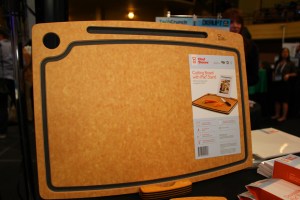
Chef Sleeve has been selling its iPad-protecting plastic sleeves since 2011 to keep kitchen gunk off the iPad you’re using while you cook. They also make a dishwasher-safe, non-porous chopping board with a built in iPad stand (below right), and a smaller stand in the same recycled paper composite finish. But Chef Sleeve’s grand plan is to create a range of connected devices for the kitchen that link up with an iPad app to let people track their nutrition in a highly granular, yet low hassle, way.
To that end it’s just kicked off a Kickstarter campaign for its next product: a smart Bluetooth scale, which it’s calling Smart Food Scales, that will enable people to weigh ingredients and snacks and then determine the exact amount of fat, salt, sugar, vitamins and so on in the ingredients they’re using in recipes or the snacks they’re eating at home.chef1
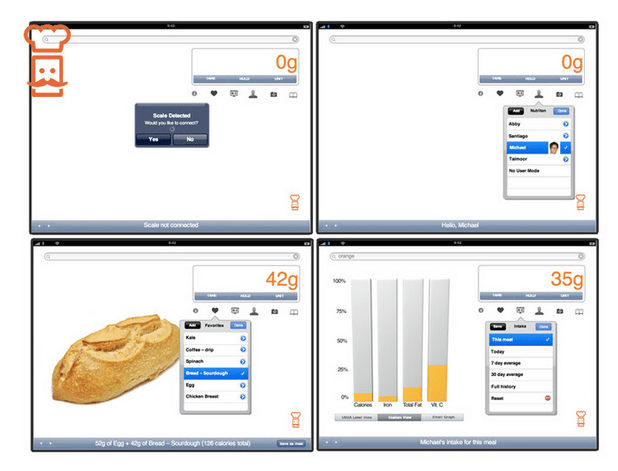
“This is our first smart product. We now want to activate these pieces of hardware and take the iPad even further and enhance the experience in the kitchen,” says Chef Sleeve’s Michael Tankenoff. “The Bluetooth scale will sync up with our iOS app on iPad or iPhone. Say you’re weighing strawberries. We house the USDA database of food information, so you select strawberries. Not only will it tell you the weight, but it tells you all the nutritional information.
“For example, you’re preparing a salad — you put your bowl on the scale, add your lettuce, select lettuce, reset to zero, add your tomatoes, select tomatoes, reset to zero, keep going, build this recipe and when you’re done, now you know exactly the nutritional value of that salad that you have every day.”
As well as the health conscious and people watching their weight, Chef Sleeve envisages the scales being useful for individuals with conditions such as diabetes to help them track their sugar intake, or people with specific nutritional deficiencies who need to make sure they’re getting enough of certain vitamins in their diet.
The company is looking to raise $30,000 via its Kickstarter campaign, which runs until the end of the month. It’s showing the following prototype screenshots (below) of the planned iPad software. It also intends to open up its API at some point in the future, so that third-party developers can build apps for the smart scales — although it’s going to be careful about how it does this, as it wants to keep any other apps wholesome (scales can, after all, be used to weigh non-foodstuffs too).
chef sleeve app
After the scales, Chef Sleeve says it will look to launch other connected devices that tie back in to its iOS app to keep adding to a range of smart kitchen devices. A thermometer could be next, says CEO Santiago Merea. A chopping board with an integrated scale could also be on the cards “at some point” — but he says the company is being mindful about its mainstream consumer buyer. “We need to be careful about our demographic. We’re not going to throw rockets at them,” he told TechCrunch. “We want the design to be very homey, very crafty.”
If the uptake of the scales is strong, it could end up generating some fascinating data for Chef Sleeve — such as what, when and how people eat — which it said it will look to feed back into its product development.
“Our pledge is going to be to not store any personal information at all — because we don’t need to but we also don’t want the risk of being hacked,” said Merea. ”Food is personal… So we’re not storing any personal information but we don’t need to. With that data we can also even help our customers. It’s going to be really cool what we can do with this.”
Chef Sleeve already has stores interested in carrying the smart scales, according to Merea. It’s hoping to get into speciality kitchenware stores with the smart scales, a shift of its retail strategy which, to date, has been mostly focused on selling via Amazon (and its own website).
Source : Techcrunch, NATASHA LOMAS, Thursday, May 2nd, 2013

Google, Nike, Jawbone and the fight to win wearable computing


Jawbone's Up wrist monitor
(Credit: Jawbone)
When wireless headset company Jawbone announced plans Tuesday to buy wearable sensor maker BodyMedia for what a source said was more than $100 million, it may well have marked a turning point for wearable computing.
The technology, which includes everything from Google Glass eyewear to heart-rate monitors to sensors that slip into running shoes, has come of age. It's moving past the niche gizmos that only appeal to geeks and gearheads.
As a real business materializes around the technology, a battle is brewing among companies that want to put themselves at the heart of it, and profit from its growth.
It's the age-old story of tech -- companies want to control the application standards on which developers build. In the 1990s, Microsoft won the platform war against IBM and became the powerhouse of the PC era. Google's Android mobile operating system is racing ahead of Apple's iOS in the platform battle for mobile dominance.
There's a reason winning the platform wars is so key. Developers have limited resources and often find themselves too stretched to create applications for more than one or two platforms. So often, they focus on the biggest. That, in turn, helps boost the platform, which then is in a stronger position to win over more developers. It becomes a virtuous cycle.

Wearable computing may never become the massive global business that PCs and mobile devices are now. But it's already caught the attention of Google, which is pushing its Google Glass. It's unclear what products might emerge using the technology. But Google's heft alone is enough to lure developers to its technology. And last month, giant Silicon Valley venture capital firms, Andreessen Horowitz and Kleiner Perkins Caufield & Byers, as well as Google's own Google Ventures, formed an investment syndicate to seed startups creating Google's Glass products.
A handful of other companies are staking their own claim as well to a wearable technology platforming, focusing on the health and fitness market that's become the biggest piece of the business.
"There is a little bit of a platform war going on," said Robin Thurston, chief executive and co-founder of MapMyFitness, a health and fitness service where athletes can log their runs and bike rides.
It's not a full-on combat just yet. MapMyFitness is developing its own platform to which some 400 devices connect, uploading various health and fitness data. But the company is also one of 10 app makers partnering with Jawbone on its Up platform, announced Tuesday, that also hopes to be attract developers.
Right now, much of the data collected from wrist monitors such as Jawbone's Up, as well as heart-rate monitors, sleep-pattern sensing devices, bicycling cyclometers and more exist in digital silos. It's not easy to look at the different collections of data at the same time to determine, for example, if a series of poor running performances might have been related to several nights of fitful sleep.

"At the end of the day, you want to see how one pattern links to another pattern," said Travis Bogard, Jawbone's vice president of product management and strategy.

That's the point of Jawbone's platform. The company also inked deals with MapMyFitness rival Runkeeper, and with Withings, which makes digital scales that send weight data wireless to PCs, among others.
"We wanted to create showcases to get developers interested," Bogard said.
And then there's Nike. The shoe and apparel giant has been pushing into consumer electronics since the 2006 introduction of its Nike+ technology, which began with a sensor that runners could slip into their shoes to track performance. It's Nike+ FuelBandunveiled a little more than a year ago, competes with Up, monitoring the steps and calories burned by users.
Nike FuelBand
Nike+ FuelBand
(Credit: Sarah Tew/CNET)
In December, the company made its own bid for developers, launching a program to offer money and mentoring to companies interested in creating health and fitness apps on top of Nike+. In March,the company awarded 10 startups $20,000 each to work from Portland, Ore., for three months to build those apps.
"We want to work with partners that have the same vision we have for health and fitness," said Nike spokesman Joseph Teegardin.
The platform battle is still young. And many of the companies vying for their spot in the center of the emerging market work with one another. But the competition suggests that wearable computing is moving from being merely a novelty, niche business.
"This is the beginning of an entirely new ecosystem of applications that will exist on top of your wearables," Jennifer Darmour, a user experience designer for the Seattle design firm Artefact and author of the Electricfoxy blog. "And that is a pretty solid indication that wearable tech is here to stay."
Source : http://news.cnet.com/, Jay Greene  May 2, 2013