Affichage des articles dont le libellé est Twitter. Afficher tous les articles

mardi 5 novembre 2013

The Three Reasons Twitter Didn’t Sell To Facebook


Facebook’s Mark Zuckerberg tried to acquire Twitter not once but twice, through official channels and via co-founder Jack Dorsey. The details of the efforts are revealed in Nick Bilton’s new book Hatching Twitter: A True Story of Money, Power, Friendship, and Betrayal.
I’ll have a full review of the book soon, but I found one passage in particular worth noting. It was late October of 2008, shortly after Dorsey had been ousted as CEO and consigned to a silent role as Chairman, with no voting stock or operational control. Fellow Twitter co-founders Ev Williams and Biz Stone had been invited to visit Facebook for a sit-down with CEO Mark Zuckerberg. The purpose? An acquisition of Twitter.

Zuckerberg, Bilton explains, had been working Dorsey for months to try to arrange a buyout. But his plans were thrown into disarray when Dorsey was yanked from the CEO slot. An email at one point to Jack had given a point-by-point reasoning on why Facebook+Twitter made sense. Among those reasons was the customary threat that Facebook could choose to ‘build products that moved further in [Twitter's] direction’, a tactic that we’ve personally heard many accounts of Zuckerberg employing. The implicit threat: sell to us or we’ll clone your product.

During the meeting, Williams and Stone threw out a valuation: $500 million. Zuckerberg was not shocked, as Dorsey had already informed him that this was the range that would be sought.
But the sale didn’t happen, and the reasoning behind the rejection was outlined in an email by Williams to the board, which is partially quoted in Bilton’s book.
It seems to me, there are three reasons to sell a company, Ev wrote in an e-mail to the board outlining why they should decline Facebook’s offer. 1. The price is good enough of or a value that the company will be in the future. (“We’ve often said that Twitter is a billion dollar company. I think it’s many, many times that,” Ev wrote.) 2. There’s an imminent and very real threat from a competitor. (Nothing is going to “pose a credible threat of taking Twitter to zero.” 3. You have a choice to go and work for someone great. (“I don’t use [Facebook]. And I have many concerns about their people and how they do business.”)
There are a few interesting points in this passage, which we’ve emphasized. First among those is that the board saw Twitter as a billion-dollar company in 2008, and Williams saw it as many times that. In 2008, Twitter had fewer than 11 million users, and had yet to see the exponential gains that would come in early 2009 as a result of publicity like Ashton Kutcher’s public race against CNN to be the first million-follower account. Twitter’s current IPO filing places a roughly $11.9 billion value on the company. Even with a crappy infrastructure still wobbling under the weight of the users it did have, Twitter’s leadership had faith.

That faith extended to the fact that there was no competitor, including Facebook, who could pose a ‘credible threat of taking Twitter to zero’. The concept of Twitter, and its execution, was so unique that even a company with Facebook’s resources was ill-equipped to mimic its behavior and success. This is reinforced by another anecdote in the book about a possible $12 million Yahoo acquisition, which was politely declined very early on in Twitter’s life. The number, even with only 250k active users of what was still an Odeo side project, seemed so low to Biz, Williams and Dorsey that it became a running joke.

And lastly, Williams was also uncomfortable about a culture mis-match. The book as a whole drills down deeply into some very flawed, very human characters. But a strain that runs throughout is that the core creators of Twitter were all looking for ways to democratize human connections. That started with Odeo and continued through to the Twitter experiment. Williams felt that Twitter could be negatively impacted by intermingling with Facebook’s company culture, and was willing to bet hundreds of millions of dollars that it would be better without that influence.

We seem to talk more and more about the mercenary nature of Silicon Valley — and the popularity of ‘acquisition as business plan’ — daily. But, it turns out, there are still people making decisions based on something other than the seven deadly sins.

And one can’t discount the impact that lightly veiled threats have on negotiations. They can often lead to a sour taste, and we’ve heard about more than one negotiation with Facebook that has been spoiled by this kind of hint-dropping. Facebook took roughly three years to clone Twitter’s core ‘follow’ feature, launching Subscribe in 2011. It was later re-named ‘Follow’.

Dorsey, for his part, was ambivalent about a Facebook acquisition, saying that “If the numbers are right, there’s a success story in either path.” At the time, he was fresh off of his removal as CEO, with little hope of getting any real power in the company back. That turned out to be wrong, thanks to friendly investor Peter Fenton, but it’s not too surprising that he saw the money as a fair trade.
But the board agreed with Williams’ reasoning and declined the offer. Zuckerberg would then go on to court Dorsey heavily, but refuse to give him a head of product position. Dorsey never went to Facebook, and when Twitter IPOs, he’ll get his voting shares back.
An interesting note: Williams actually blogged about the offer, and the three reasons, earlier this year but never disclosed that it was Facebook. An interesting quote from the piece:
At the time, the offer we had on the table for Twitter—though a heck of a lot of money and a huge win for investors and anyone else involved—didn’t seem like it captured the upside. Even though we weren’t huge, and there were still a lot of doubters, I believed our potential was unbounded.

In the Twitter case, we had no desire to sell. I had actually just become CEO and was raring to go—as was the team. Additionally, the company we were having the discussion with didn’t seem like one in which we’d fit particularly well or the team would be stoked about.
The passage presents us with an intriguing alternate reality where Facebook acquired Twitter, establishing an essential monopoly on the world’s largest and most recognizable social networks. And an example of how it’s still possible to mesh the concepts of business acumen and moral code.
[Photo: (CC) Flickr/Randy Stewart, blog.stewtopia.com]

Source : Techcrunch

vendredi 4 octobre 2013

Twitter Has Been Making 80 Cents In Ad Revenue For Every Thousand ‘Timeline Views’

twitter ad timeline
If you’re reading Twitter’s S-1 filing to see where the business stands as it prepares to go public (hey, that’s what everyone’s doing at TechCrunch), you may have noticed a number that comes up repeatedly: “advertising revenue per timeline view.”

What does that actually mean? Twitter says that along with things like monthly active users, ad revenue per timeline view is one of the key metrics it uses to evaluate its business. The company treats timeline views (“the total number of timelines requested when registered users visit Twitter, refresh a timeline or view search results while logged in on our website, mobile website or desktop or mobile applications”) as a measure of user engagement, and it uses ad revenue per timeline view to track its ability to make money from that engagement.

By that measure, Twitter’s ability to monetize is improving. It says advertising revenue per timeline view was $0.80 for the three months ending on June 30 of this year, up 26 percent from the same period in 2012. That number is significantly higher in the United States ($2.17) compared to the rest of the world ($0.30), though the international number is up 111 percent year-over-year.

Why invent an entirely new ad metric (and one without a handy acronym)? Well, Twitter has an unusual advertising model, with advertisers paying to promote tweets, trends, and accounts in users’ news feeds, so the standard ad measurement of CPMs (the cost per thousand impressions) may not apply. The fact that “advertising revenue per timeline view” actually measures revenue for every 1,000 timeline views suggests that this metric may be a proxy of sorts for CPMs.

(It’s probably a little dodgy to compare Twitter’s numbers with traditional CPMs, but hey, just for fun — according to eMarketer, Facebook had an effective CPM of $.071 on mobile and $0.19 on desktop in 2012.)

However, Twitter is really selling its ads as a way for companies to engage with consumers, so the filing also notes trends in cost per ad engagement — basically, it’s been falling steadily, with a sequential decrease of 46 percent in the last quarter, 12 percent the quarter before that, and 19 percent the quarter before that. (A decline in cost means Twitter is getting paid less for each engagement.) The filing attributes these declines to an increase in ad inventory, which has been partially offset by growing demand.

Advertising also gets its own section (page 18 if you want to read along) in the filing’s discussion of various risk factors, where Twitter notes that all kinds of things could go wrong with its ad programs — for example, if Twitter is unable to convince brands to invest in building a presence on the service, or if new programs like its video-based Amplify ads don’t take off, or if the decline in cost per engagement continues.

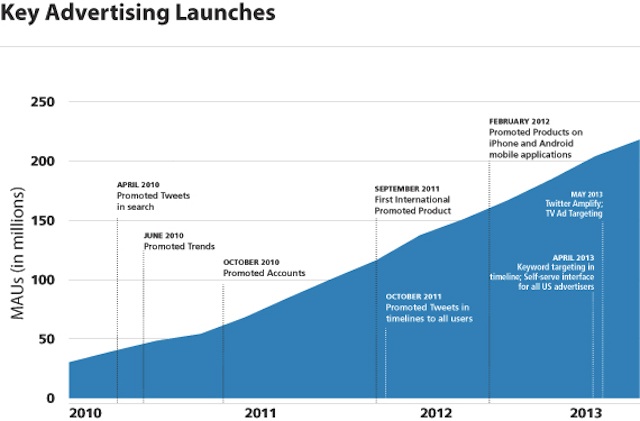
As we wrote earlier, Twitter brought in $253 million in revenue in the first six months of the year. Of that amount, $221 million (87 percent) came from ads, compared to $32 million (13 percent) from data licensing. In comparison, the company made $7 million from advertising in all of 2010 (that’s when it launched its first ad programs) and $21 million from data licensing. Oh, and Twitter says that mobile accounts for 65 percent of its ad revenue.

Source : Techcrunch

mercredi 13 février 2013

Payer ses achats avec un tweet sera désormais possible

Twitter et American Express sont en train de tester la possibilité pour les utilisateurs du réseau social de pouvoir payer leurs achats, services ou biens virtuels via un simple tweet, selon ce que rapporte le Wall Street Journal.
Et si Twitter tenait là sa future vache à lait de son modèle économique ? En tout cas cela me paraît intéressant à plus d’un titre. Premièrement pour le consommateur le fait de pouvoir payer avec un simple tweet via un #hashtag spécial, cela simplifie la vie. Et pour le réseau social, une commission sur chaque achat serait synonyme de rentabilité et ferait de Twitter une nouvelle place de marché virtuelle.
Amex Card

Comment cela fonctionne ?
Un utilisateur mentionne dans un tweet un hashtag qui montre son intention de faire un achat. En retour le compte @AmexSync envoie un hashtag de confirmation à l’acheteur potentiel. Une fois que l’utilisateur a retweeté le hashtag de confirmation, American Express envoie un email donnant 15 minutes à l’utilisateur pour confirmer son achat. Une fois fait, sa carte Amex est débitée automatiquement et son produit acheté est envoyé.
Pour tester ce partenariat, Twitter et Amex proposent aux américains une carte de certificat cadeau de 25$ à un prix de 15$, et seulement quelques produits sont proposés à l’achat dans un premier temps (avant que ce soit rendu un équivalent d’Amazon, ce n’est pas demain matin non plus) comme des tablettes Kindle Fire, des camescopes Sony Action, la Xbox 360 et des bijoux Donna Karan. La liste de tous les produits vendus via Twitter est visible dans la section “Favoris” du compte @AmericanExpress.

En passant d’un modèle de revenus plus aléatoire basé sur la publicité, Twitter ajouterait ici des revenus transactionnels, ce qui solidifierait l’entreprise pour le long terme et ferait certainement bondir sa valorisation (10 milliards de dollars actuellement). Vu que c’est pour l’instant en mode beta, il faudra voir comment cette nouvelle fonctionnalité du réseau social sera accueillie par ses utilisateurs.

Source : Vincent Abry

jeudi 31 janvier 2013

Prévenir les épidémies grâce aux données de géo-localisation de Twitter?


red map of the United States with indicators of diseases


Les GPS, les données des utilisateurs et d'autres facteurs peuvent fournir aux chercheurs médicaux et aux organes officiels un nouveau mode de suivi des épidémies. La localisation peut aider à suivre l'évolution de la maladie ainsi que d'autres problèmes de santé publique.

Twitter s'est avéré un outil utile pour étudier la façon dont une maladie se répand, et les chercheurs compilent actuellement les messages et les données de localisation des utilisateurs afin de déterminer la meilleure façon d'utiliser ce réseau social à cet effet. Le Journal of Medical Research a récemment publié l'article “Right Time, Right Place” relatif à la pertinence de ce contenu dans la gestion de la communication médicale, à savoir qu'il existe « sur Twitter différents indicateurs de géo-localisation et que, pris ensemble, ils offrent un échantillon significatif d'individus dont on peut déduire, avec précision, la position. » Les auteurs estiment que cela pourrait avoir une influence sur la façon dont les organisations médicales étudient et compilent l'information pour communiquer « en temps utile, au bon endroit ».

Twitter presqu'aussi précis que les enquêtes traditionnelles
L'étendue de la population des utilisateurs de Twitter ne fournit peut-être qu'un petit pourcentage de coordonnées GPS fiables (2,7%), mais cet échantillon de données reste valable car il correspond à des centaines de milliers de tweets échangés sur une période de 2 semaines, temps consacré à cette étude. Les informations GPS et les informations de position fournies par l'utilisateur permettent de recueillir des données de géo-localisation fiables sur environ 15 à 17% des utilisateurs. Pour valider l'utilité de la taille leur échantillon, les auteurs ont comparé ces résultats à une enquête de Pew, et ils sont arrivés à des résultats statistiques comparables. Mais en utilisant Twitter, les chercheurs limitent le taux d'informations moins fiables, tout en bénéficiant de la rapidité et d'autres facteurs dont ne dispose pas l'approche traditionnelle.

Apporter un éclairage sur d'autres problèmes et démocratiser l'épidémiologie
Outre le potentiel dans la détection et le suivi des épidémies, d'autres problèmes de santé publique peuvent être mieux cernés. Parmi les problèmes ayant fait l'objet d'études récentes et repris dans l'étude « Right Time, Right Place » figurent les problèmes liés au tabac, à la boisson, aux maux dentaires et à l'allaitement. L'observation d'un contenu de santé généré, en temps réel, par l'utilisateur a entraîné un nouveau volume important de données de santé transmises par texte, images et vidéo. Étant donnée la diversité démographique des utilisateurs de Twitter, les auteurs suggèrent que les disparités dans le domaine de la santé pourraient être réduites en étant plus attentif et en communiquant aux groupes sous-représentés et à la population à faibles revenus.

Source: L'Atelierhttp://www.atelier.net/trends/articles/prevenir-epidemies-grace-aux-donnees-de-geo-localisation-de-twitter?

mercredi 16 janvier 2013

In India, vending machine billboard offers free shirts for tweets

The most recent marketing campaign for fashion designer Allen Solly has seen the company exchange tweets for men’s shirts.
alttext 
Brand mentions on social networks have already become sufficiently sought-after to warrant payback of free wifi and pizza in the recent past. Joining this trend, the most recent marketing campaign for Indian fashion designer Allen Solly has seen the company exchange tweets for men’s shirts.Created by the India branch of advertising agency Ogilvy, the campaign saw a large billboard kitted out with 60 shirts and a mechanism that pushed each one forward a small amount everytime someone tweeted with the hashtag ‘#RainingSolly’. According to reports, people around the billboard were then invited to use their phones to interact with it, while a large screen displayed their tweets. The user who tweeted at the moment a shirt was released could collect it for free. The following video shows how the campaign worked:


The Allen Solly campaign is another example of a company encouraging social media activity in exchange for products. Could this sort of marketing work for your business?