mercredi 27 novembre 2013

Is Bitcoin about to change the world?

If you want to buy drugs or guns anonymously online, virtual currency Bitcoin is better than hard cash. Canny speculators have been hoarding it like digital gold. Now the world's leading bankers are even talking about as a rival for real money. How does it work, where can you get it and is it the future.
A sign above a bar in Germany.
A sign above a bar in Germany. Photograph: Alamy
The past weeks have seen a surprising meeting of minds between chairman of the US Federal Reserve Ben Bernanke, the Bank of England, the Olympic-rowing and Zuckerberg-bothering Winklevoss twins, and the US Department of Homeland Security. The connection? All have decided it's time to take Bitcoin seriously.
Until now, what pundits called in a rolling-eye fashion "the new peer-to-peer cryptocurrency" had been seen just as a digital form of gold, with all the associated speculation, stake-claiming and even "mining"; perfect for the digital wild west of the internet, but no use for real transactions.
Bitcoins are mined by computers solving fiendishly hard mathematical problems. The "coin" doesn't exist physically: it is a virtual currency that exists only as a computer file. No one computer controls the currency. A network keeps track of all transactions made using Bitcoins but it doesn't know what they were used for – just the ID of the computer "wallet" they move from and to.
Right now the currency is tricky to use, both in terms of the technological nous required to actually acquire Bitcoins, and finding somewhere to spend them. To get them, you have to first set up a wallet, probably online at a site such as Blockchain.info, and then pay someone hard currency to get them to transfer the coins into that wallet.
A Bitcoin payment address is a short string of random characters, and if used carefully, it's possible to make transactions anonymously. That's what made it the currency of choice for sites such as the Silk Road and Black Market Reloaded, which let users buy drugs anonymously over the internet. It also makes it very hard to tax transactions, despite the best efforts of countries such as Germany, which in August declared that Bitcoin was "private money" in which transactions should be taxed as normal.
It doesn't have all the advantages of cash, though the fact you can't forge it is a definite plus: Bitcoin is "peer-to-peer" and every coin "spent" is authenticated with the network. Thus you can't spend the same coin in two different places. (But nor can you spend it without an internet connection.) You don't have to spend whole Bitcoins: each one can be split into 100m pieces (each known as a satoshi), and spent separately.
Although most people have now vaguely heard of Bitcoin, you're unlikely to find someone outside the tech community who really understands it in detail, let alone accepts it as payment. Nobody knows who invented it; its pseudonymous creator, Satoshi Nakamoto, hasn't come forward. He or she may not even be Japanese but certainly knows a lot about cryptography, economics and computing.
It was first presented in November 2008 in an academic paper shared with a cryptography mailing list. It caught the attention of that community but took years to take off as a niche transaction tool. The first Bitcoin boom and bust came in 2011, and signalled that it had caught the attention of enough people for real money to get involved – but also posed the question of whether it could ever be more than a novelty.
The algorithm for mining Bitcoins means the number in circulation will never exceed 21m and this limit will be reached in around 2140. Already 57% of all Bitcoins have been created; by 2017, 75% will have been. If you tried to create a Bitcoin in 2141, every other computer on the network would reject it as fake because it would not have been made according to the rules of currency.
The number of companies taking Bitcoin payments is increasing from a small base, and a few payment processors such as Atlanta-based Bitpay are making real money from the currency. But it's difficult to get accurate numbers on conventional transactions, and it still seems that the most popular uses of Bitcoins are buying drugs in the shadier parts of the internet, as people did on the Silk Road website, and buying the currency in the hope that in a few weeks' time you will be able to sell it at a profit.
This is remarkable because there's no fundamental reason why Bitcoin should have any value at all. The only reason people are willing to pay money for the currency is because other people are willing to as well. (Try not to think about it too hard.) Now, though, sensible economists are saying that Bitcoin might become part of our future economy. That's quite a shift from October last year, when the European Central Bank said that Bitcoin was "characteristic of a Ponzi [pyramid] scheme". This month, the Chicago Federal Reserve commented that the currency was "a remarkable conceptual and technical achievement, which may well be used by existing financial institutions (which could issue their own bitcoins) or even by governments themselves".
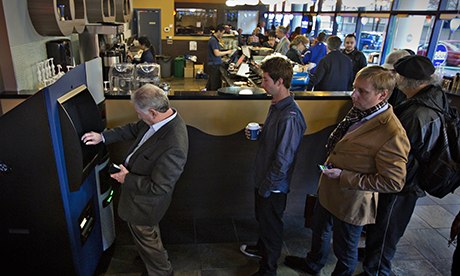
The First Bitcoin ATM, in Canada.The First Bitcoin ATM, in Canada. Photograph: REUTERS
It might not sound thrilling. But for a central banker, that's like yelling "BITCOIIINNNN!" from the rooftops. And Bernanke, in a carefully dull letter to the US Senate committee on Homeland Security, said that when it came to virtual currencies (read: Bitcoin), the US Federal Reserve had "ongoing initiatives" to "identify additional areas of … concern that require heightened attention by the banking organisations we supervise".
In other words, Bernanke is ready to make Bitcoin part of US currency regulation – the key step towards legitimacy.
Most reporting about Bitcoin until now has been of its extraordinary price ramp – from a low of $1 in 2011 to more than $900 earlier this month. That massive increase has sparked a classic speculative rush, with more and more people hoping to get a piece of the pie by buying and then selling Bitcoins. Others are investing thousands of pounds in custom "mining rigs", computers specially built to solve the mathematical problems necessary to confirm a Bitcoin transaction.
But bubbles can burst: in 2011 it went from $33 to $1. The day after hitting that $900 high, Bitcoin's value halved on MtGox, the biggest exchange. Then it rose again.
Speculative bubbles happen everywhere, though, from stock markets to Beanie Babies. All that's needed is enough people who think that they are the smart money, and that everyone else is sufficiently stupid to buy from them. But the Bitcoin bubbles tell us as much about the usefulness of the currency itself as the tulip mania of 17th century Holland did about flower-arranging.
History does provide some lessons. While the Dutch were selling single tulip bulbs for 10 times a craftsman's annual income, the British were panicking about their own economic crisis. The silver coinage that had been the basis of the national economy for centuries was rapidly becoming unfit for purpose: it was constrained in supply and too easy to forge. The economy was taking on the features of a modern capitalist state, and the currency simply couldn't catch up.
Describing the problem Britain faced then, David Birch, a consultant specialising in electronic transactions, says: "We had a problem in matching the nature of the economy to the nature of the money we used." Birch has been talking about electronic money for over two decades and is convinced that we find ourselves on the edge of the same shift that occurred 400 years ago.
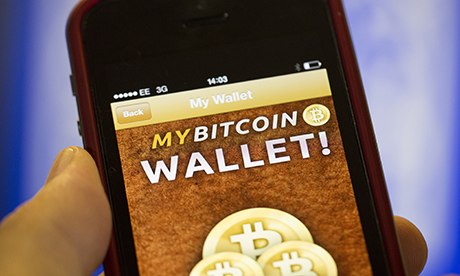
A Bitcoin wallet on a smartphone.A Bitcoin wallet on a smartphone. Photograph: Bloomberg via Getty Images
The cause of that shift is the internet, because even though you might want to, you can't use cash – untraceable, no-fee-charged cash – online. Existing payment systems such as PayPal and credit cards demand a cut. So for individuals looking for a digital equivalent of cash – no middleman, quick, easy – Bitcoin looks pretty good.
In 1613, as people looked for a replacement for silver, Birch says, "we might have been saying 'the idea of tulip bulbs as an asset class looks pretty good, but this central bank nonsense will never catch on.' We knew we needed a change, but we couldn't tell which made sense." Back then, the currency crisis was solved with the introduction first of Isaac Newton's Royal Mint ("official" silver and gold) and later with the creation of the Bank of England ("official" paper money that could in theory be swapped for official silver or gold).
And now? Bitcoin offers unprecedented flexibility compared with what has gone before. "Some people in the mid-90s asked: 'Why do we need the web when we have AOL and CompuServe?'" says Mike Hearn, who works on the programs that underpin Bitcoin. "And so now people ask the same of Bitcoin. The web came to dominate because it was flexible and open, so anyone could take part, innovate and build interesting applications like YouTube, Facebook or Wikipedia, none of which would have ever happened on the AOL platform. I think the same will be true of Bitcoin."
For a small (but vocal) group in the US, Bitcoin represents the next best alternative to the gold standard, the 19th-century conception that money ought to be backed by precious metals rather than government printing presses and promises. This love of "hard money" is baked into Bitcoin itself, and is the reason why the owners who set computers to do the maths required to make the currency work are known as "miners", and is why the total supply of Bitcoin is capped.
And for Tyler and Cameron Winklevoss, the twins who sued Mark Zuckerberg (claiming he stole their idea for Facebook; the case was settled out of court), it's a handy vehicle for speculation. The two of them are setting up the "Winklevoss Bitcoin Trust", letting conventional investors gamble on the price of the currency.
Some of the hurdles left between Bitcoin and widespread adoption can be fixed. But until and unless Bitcoin develops a fully fledged banking system, some things that we take for granted with conventional money won't work.
Others are intrinsic to the currency. At some point in the early 22nd century, the last Bitcoin will be generated. Long before that, the creation of new coins will have dropped to near-zero. And through the next 100 or so years, it will follow an economic path laid out by "Nakomoto" in 2009 – a path that rejects the consensus view of modern economics that management by a central bank is beneficial. For some, that means Bitcoin can never achieve ubiquity. "Economies perform better when they have managed monetary policies," the Bank of England's chief cashier, Chris Salmon, said at an event to discuss Bitcoin last week. "As a result, it will never be more than an alternative [to state-backed money]." To macroeconomists, Bitcoin isn't scary because it enables crime, or eases tax dodging. It's scary because a world where it's used for all transactions is one where the ability of a central bank to guide the economy is destroyed, by design.
For Bitcoin developer Hearn, that's not a concern. "Bitcoin's monetary policy would only be relevant if it were to be adopted by an entire economy, which isn't going to happen any time soon."
Already, alternatives based on Bitcoin have sprung up: for instance, Litecoin speeds up transaction processing and Freicoin introduces measures to stop people hoarding their money, but both are essentially the same technology, "forked" from the original. There's even nothing to stop a nation state declaring its own version of Bitcoin as legal tender.
So even if the currency of the future looks like Bitcoin, it might end up being a distant successor of the pioneer. "Is the technology of Bitcoin a window into the future?" asks Birch. "Yes. Is Bitcoin itself? No."
Source : The Guardian

mardi 26 novembre 2013

Le secteur de la bijouterie peut-il constituer un débouché pour les objets connectés?

technologie et bijouLe développement de boucles d'oreilles connectées enregistrant les données biométriques des patients pose la question de la transposition du modèle connecté au sein de l'industrie du luxe.

Secteur de la bijouterie et objets connectés sont-ils amenés à converger ? C’est la question que l’on peut se poser au vu des différents prototypes, mis en place récemment, s’appuyant sur des accessoires tels que les montres (Pebble, Galaxy Gear…) ou encore les bracelets (NikeFuel Band, Kapture...). Consciente de possibilités ouvertes par ces nouvelles générations de capteurs, l'équipe du Professeur David Kotz de l'Université de Dartmouth a choisi de miser sur cette tendance et a développé, pour sa part, une approche des objets connectés à usage médical via la joaillerie, à travers leur projet Amulet.

Un bijou certes mais à usage médical

Le projet Amulet consisterait ainsi en un système étendu de capteurs biométriques intégrés au sein d'objets du quotidien, accessoires, vêtements et plus particulièrement des bijoux, faisant office de serveur de stockage et d'analyse directement en lien avec les médecins. A la différence des smartphones que l'on ne porte pas forcément constamment sur soi, ceux-ci seraient à même d'offrir des informations plus précises et continues. Le but est ainsi d'arriver à un meilleur résultat au point de vue médical, tout en normalisant l'objet connecté. "Le marché va réellement s'étendre quand la technologie deviendra plus cachée dans un objet connecté qui ne ressemble pas à un produit technologique, puisque tout le monde n'aime pas cet aspect." De plus, selon ses créateurs, si le nombre d'applications médicales disponibles sur les smartphones s'est vu croître de manière exponentielle durant les derniers mois, les smartphones, n'étant pas spécialisés pour de telles applications, sont plus vulnérables. "A la différence des objets connectés spécifiquement conçus pour des applications médicales, les smartphones qui supportent un vaste champ d'application, notamment email ou Internet, posent un plus grand risque d'être confrontés à des logiciels malveillants." explique David Kotz.

Point d'entrée du marché

De par leur plus-value technologique, mais aussi de par leur prix logiquement nettement plus élevé que leurs pendants non connectés, ces objets et bijoux connectés semblent se rapprocher du marché du luxe. A l'image des smartphones, ce peut être via une approche financièrement discriminée que les objets connectés pourraient pénétrer le marché, via une réduction graduelle des coûts d'échelle, notamment dans la systématisation de capteurs sophistiqués. "Il y a un fort marché potentiel pour les objets connectés au sein du luxe et des secteurs de haute qualité, du fait notamment de la volonté des consommateurs et du changement de mode de pensée." explique Uché Okonkwo-Pézard, Directrice Executif du cabinet de consultant Luxe Corp. Celle-ci ajoute "Ils n'interagissent plus avec la technologie sur une base isolée mais ont complètement intégré les produits digitaux au sein de leur mode de vie." Cependant si le développement de tels produits peut créer un marché pour les utilisateurs connectés, il pourrait s'avérer difficile, au sein du luxe d'en dépasser l'aspect gadget. Comme l'explique Uché Okonkwo-Pézard, "Dans le luxe, le symbole est plus important que la fonction, il doit donc toujours y avoir un certain équilibre."
Source : L'Atelier

mercredi 20 novembre 2013

Indiegogo or Kickstarter ?

On apples, oranges, and crowdfunding platforms: Indiegogo’s recent growth highlights the difference between it and Kickstarter
indiegogo_kickstarter_final
Indiegogo, the crowdfunding platform founded two years before media darling Kickstarter, is today revealing its growth over the last few years. The typically tight-lipped company revealed this information exclusively to PandoDaily after disputing data used to create an infographic comparing the two platforms that relied on Kickstarter’s public statistics and third-party information about Indiegogo’s platform. (Mea culpa, mea culpa, mea maxima culpa.)
Slava Rubin, the company’s co-founder and chief executive, says that Indiegogo has now managed more than 150,000 projects and is hosting another 7,000 each week. That’s more than the 4,374 live projects Kickstarter reports on its website, though that doesn’t account for the discrepancy between the number of countries in which both companies operate. Indiegogo allows anyone from some 200 countries to create a campaign; Kickstarter only allows approved projects from the US, UK, Canada, Australia, and New Zealand onto its site.
That discrepancy highlights the differences between Indiegogo and Kickstarter. The former is focused on allowing anyone to raise any amount of money from anywhere in the world; the latter is focused on creating a highly-curated platform that allows a select few to raise money from their fans. This focus has led to rapid international growth on Indiegogo’s part, as Rubin says that the company is now distributing funds to between 70 and 100 countries each month; seen its transaction volume outside of the US triple over the last year; and transferred money to some 190 countries since its launch.
While the numbers themselves are news, their meaning — that Indiegogo and Kickstarter aren’t quite the competitors some might think — is not. As we noted in the revised introduction to our infographic:
We will grant Indiegogo that it and Kickstarter, while both crowdfunding modules, have different models. Indiegogo accepts anybody. Kickstarter does not. Indiegogo gives campaigns the option of keeping all of the money if they miss their goal. Kickstarter does not. So yes, while Lau and Junprung’s data may paint a picture of Kickstarter dominance, it’s also not an apples-to-apples comparison.
Have high-profile Kickstarter projects raised more than similar projects on Indiegogo? Absolutely. Does Indiegogo’s willingness to open its platform for nearly anything, whether it’s a state-of-the-art smartphone or a campaign to send an abused bus monitor on a vacation, allow the company’s service to be used for a wider variety of purposes than Kickstarter? Definitely. These services both have their own strengths and weaknesses, and there’s no reason that they can’t co-exist.
Perhaps that is the greatest lesson to be learned from Indiegogo’s revelations. The company has declined to reveal much about itself — using percentages to describe growth is a fickle, easily abused trick — and much of what it has revealed won’t stifle criticism of the service. These numbers are only useful insofar as their ability to lend further credence to the idea that comparing Indiegogo and Kickstarter simply because both operate crowdfunding platforms is as ludicrous as comparing apples and oranges simply because both grow on trees.
[Illustration by Hallie Bateman for Pandodaily]
Source : Pandodaily.com, by Nathaniel Mott

Motorola créé un tatouage permettant de passer des appels

Motorola vient de déposer un brevet pour un nouvel outil de communication semblable à un tatouage permettant notamment de passer des appels plus audibles dans les lieux bruyants.
Motorola et son tatouage connecté

Bien qu’encore assez marginal, le marché des outils connectés est en plein essor. Les acteurs du digital et des télécommunications redoublent de créativité pour faciliter la vie des consommateurs. Après les Google Glass, les smartwatches et autres outils connectés, Motorola surenchéri avec son “tatouage connecté”. L’entreprise Américaine appartenant depuis 2011 à Google cherche à renverser la notion traditionnelle du Smartphone.  En mai 2013, Motorola avait annoncé qu’il cherchait à remplacer les mots de passe traditionnels avec des tatouages ​​électroniques ou des pilules d'authentification que les gens avalent. Aujourd’hui, Motorola dépose un brevet intitulé “Coupling An Electronic Skin Tattoo To A Mobile Communication Device,” afin de protéger son invention de tatouage connecté muni d’un microphone.

Une technologie de communication intégrée dans le corps

Ce surprenant dispositif correspond à un tatouage électronique et autocollant fixée sur la gorge de son utilisateur. Il permet de communiquer sans fil en utilisant un réseau WiFi, Bluetooth ou NFC. C’est en fait un émetteur-récepteur capable d’améliorer la qualité sonore en réduisant les bruits ambiants. Il est compatible avec la plupart des appareils mobiles  tels que les smartphones, tablettes, consoles de jeux portable et autres objets connectés. Il est précisé qu’il doit aussi être changé en moyenne chaque semaine et qu’il peut également être appliqué sur les animaux.Le brevet déposé par Motorola ne donne bien entendu que peu de précisions sur l’invention même, ses applications ou encore sa production future. Certains analystes supposent que le tatouage utilisera l’énergie solaire pour fonctionner.

Un avenir à déterminer

Aujourd’hui, il n’existe aucune projection sur l’avenir de ce produit. Il se peut que Motorola cherche à créer des concepts et les protège afin d’empêcher de nouveaux acteurs d'essayer de développer un concept similaire. Il ne faut donc pas spécialement s’attendre à retrouver ce produit sur le marché dans les jours à venir. Ce type de dispositif serait déjà utilisé dans le domaine militaire. Selon Patrick Moorhead, analyste chez Moor Insights & Strategy, l'armée utiliserait déjà des microphones de gorge pour rendre les communications plus claires. De plus, nous n’avons pas de recul pour connaître les effets secondaires que peuvent provoquer cette technologie. Concernant les interrogations sur les problèmes de santé que cette technologie peu engendrer, Motorola reste silencieux.Dans l’avenir ce dispositif pourrait même être utilisé comme un détecteur de mensonges. Le tatouage inclurait ainsi un détecteur de réponse galvanique (utilisant les courants électriques du corps). En effet, la réponse galvanique de la peau est différente lorsque l’individu est nerveux, dit des mensonges ou lorsqu’il est confiant et dit la vérité. Enfin, ce système pourrait aussi permettre de contrôler son smartphone avec la voix. L’annonce du dépôt de brevet par Motorola manifeste certainement le début d’une nouvelle ère d’objets connectés, intégrés au corps humain.
Source : L'Atelier

mercredi 13 novembre 2013

Boku permet de payer sa place de parking d’un simple sms

BokuLes services de carrier billing se multiplient, simplifiant le paiement et poussant les géants high-tech à nouer des partenariats pour intégrer ces fonctionnalités.

Usages en plein expansion dans le domaine du m-paiement, les services de carrier billing permettent aux utilisateurs de payer divers produits notamment sur les réseaux sociaux et plateformes d’applications en utilisant des crédits téléphoniques pouvant être directement mobilisés par sms. Paradoxalement il s’agit de l’une des formes les plus anciennes de paiement sur mobile, développés dès l’apparition des premiers appareils pour acheter des fonds d’écran ou sonneries spécifiques par exemples. Mais aujourd’hui il s’agit d’un service  indispensable au développement dumarché des applications estimé à près de 25 milliards de dollars. Plusieurs acteurs tentent à présent d’intégrer ces services mobiles dans des usages du quotidien.

Le carrier billing à l’assaut du monde réel

L’entreprise de carrier billing basée à San Francisco,Boku après avoir développé ses services sur différentes plateformes et réseaux sociaux étend son marché au monde réel avec un premier partenariat. En collaboration avec PassportParking l’entreprise permet aux usagers de plusieurs grandes villes américaines de payer leurs places de parking directement par sms, mettant fin ainsi aux appoints approximatifs aux parcmètres. Cette incursion d’un service à l’origine exclusivement digital dans des usages quotidiens et physiques marque une étape menant à la généralisation du carrier billing.  Boku utilise en effet la même technique au cœur de sa chaîne de valeur d’origine, les utilisateurs de PassportParking payent directement leur facture grâce à leur numéro de téléphone, le montant étant déduit du forfait géré par l’opérateur et nom d’un compte en banque ou autre porte-monnaie digital.  

Une tendance qui affecte les géants du e-commerce et des mobiles

Le carrier billing  s’affirme de plus en plus comme tendance de fond affectant transversalement les acteurs digitaux, comme le souligne Jon Prideaux CBO de Boku : « Depuis un an, le carrier billing s’impose progressivement comme une méthode de paiement privilégiée sur des nouveaux appareils connectés comme la TV connectée ou encore les nouvelles consoles de jeux . » Amazon a ainsi annoncé il y a quelques mois un partenariat avec Bango, l’un des leaders mondiaux du carrier billing pour offrir à ses clients la possibilité de payer leurs achats grâce à leurs crédits téléphoniques.  Ce partenariat devrait se concrétiser sous la forme d’application Amazon pour Android, la tendance du carrier billing se répandant à la fois chez les acteurs de l’e-commerce et chez les développeurs d’appareils connectés ( mobiles, tablettes etc). De même Microsoft offre maintenant l’application Bango sur son Windows Phone Store, visant dans un premier temps le marché de l’Asie du Sud-Est avant de s’étendre globalement.
Source : L'Atelier

jeudi 7 novembre 2013

Fast food for the digital age: Meals are 3D-printed

Two new startups could help bring individual customization to the mass production of meals with 3D printed food.

alttext
The 20th century ushered in the age of mass produced food, which — for better or worse — has fed the population with an endless array of new dishes and delicacies. The 21st century food industry may come to be about the individual customization with 3D printed food, however, if two new startups get their way.

Headed by Hod Lipson and Jeffrey Lipton, the Cornell Creative Machines Lab (CCML) is a part of Cornell University researching 3D printing. Having already worked with the International Culinary Center, its prototypes can create scallop nuggets in novelty shapes, cakes with messages printed inside, noodles and hamburger patties. The devices currently take liquid and paste foodstuffs such as melted chocolate, dough and pureed goods, which can be used much like the plastic in typical 3D printers.

Barcelona-based Natural Machines (above) is another startup moving the world of catering into 3D printed territory. According to the Wall Street Journal, the startup uses precise piping directed by digital designs to create pastas, breads and food decorations. It is already in the process of developing a printer for market, which it hopes to retail for EUR 1,000. Connected to the web, users will be able to download recipes and designs, as well as tweet their latest creations.

While regular readers of Springwise may remember Japan-based FabCafe‘s 3D-printed Valentine’s Day jelly sweets, both the research by CCML and Natural Machines could bring the production of digitally-designed meals out of science fiction and into reality. Could your business benefit from the convenience of 3D food printing?

Website: www.creativemachines.cornell.edu / www.naturalmachines.com
Contact: hod.lipson@cornell.edu / www.twitter.com/naturalmachines
Spotted by Murray Orange, written by Springwise

Source : Springwise

mardi 5 novembre 2013

The Three Reasons Twitter Didn’t Sell To Facebook


Facebook’s Mark Zuckerberg tried to acquire Twitter not once but twice, through official channels and via co-founder Jack Dorsey. The details of the efforts are revealed in Nick Bilton’s new book Hatching Twitter: A True Story of Money, Power, Friendship, and Betrayal.
I’ll have a full review of the book soon, but I found one passage in particular worth noting. It was late October of 2008, shortly after Dorsey had been ousted as CEO and consigned to a silent role as Chairman, with no voting stock or operational control. Fellow Twitter co-founders Ev Williams and Biz Stone had been invited to visit Facebook for a sit-down with CEO Mark Zuckerberg. The purpose? An acquisition of Twitter.

Zuckerberg, Bilton explains, had been working Dorsey for months to try to arrange a buyout. But his plans were thrown into disarray when Dorsey was yanked from the CEO slot. An email at one point to Jack had given a point-by-point reasoning on why Facebook+Twitter made sense. Among those reasons was the customary threat that Facebook could choose to ‘build products that moved further in [Twitter's] direction’, a tactic that we’ve personally heard many accounts of Zuckerberg employing. The implicit threat: sell to us or we’ll clone your product.

During the meeting, Williams and Stone threw out a valuation: $500 million. Zuckerberg was not shocked, as Dorsey had already informed him that this was the range that would be sought.
But the sale didn’t happen, and the reasoning behind the rejection was outlined in an email by Williams to the board, which is partially quoted in Bilton’s book.
It seems to me, there are three reasons to sell a company, Ev wrote in an e-mail to the board outlining why they should decline Facebook’s offer. 1. The price is good enough of or a value that the company will be in the future. (“We’ve often said that Twitter is a billion dollar company. I think it’s many, many times that,” Ev wrote.) 2. There’s an imminent and very real threat from a competitor. (Nothing is going to “pose a credible threat of taking Twitter to zero.” 3. You have a choice to go and work for someone great. (“I don’t use [Facebook]. And I have many concerns about their people and how they do business.”)
There are a few interesting points in this passage, which we’ve emphasized. First among those is that the board saw Twitter as a billion-dollar company in 2008, and Williams saw it as many times that. In 2008, Twitter had fewer than 11 million users, and had yet to see the exponential gains that would come in early 2009 as a result of publicity like Ashton Kutcher’s public race against CNN to be the first million-follower account. Twitter’s current IPO filing places a roughly $11.9 billion value on the company. Even with a crappy infrastructure still wobbling under the weight of the users it did have, Twitter’s leadership had faith.

That faith extended to the fact that there was no competitor, including Facebook, who could pose a ‘credible threat of taking Twitter to zero’. The concept of Twitter, and its execution, was so unique that even a company with Facebook’s resources was ill-equipped to mimic its behavior and success. This is reinforced by another anecdote in the book about a possible $12 million Yahoo acquisition, which was politely declined very early on in Twitter’s life. The number, even with only 250k active users of what was still an Odeo side project, seemed so low to Biz, Williams and Dorsey that it became a running joke.

And lastly, Williams was also uncomfortable about a culture mis-match. The book as a whole drills down deeply into some very flawed, very human characters. But a strain that runs throughout is that the core creators of Twitter were all looking for ways to democratize human connections. That started with Odeo and continued through to the Twitter experiment. Williams felt that Twitter could be negatively impacted by intermingling with Facebook’s company culture, and was willing to bet hundreds of millions of dollars that it would be better without that influence.

We seem to talk more and more about the mercenary nature of Silicon Valley — and the popularity of ‘acquisition as business plan’ — daily. But, it turns out, there are still people making decisions based on something other than the seven deadly sins.

And one can’t discount the impact that lightly veiled threats have on negotiations. They can often lead to a sour taste, and we’ve heard about more than one negotiation with Facebook that has been spoiled by this kind of hint-dropping. Facebook took roughly three years to clone Twitter’s core ‘follow’ feature, launching Subscribe in 2011. It was later re-named ‘Follow’.

Dorsey, for his part, was ambivalent about a Facebook acquisition, saying that “If the numbers are right, there’s a success story in either path.” At the time, he was fresh off of his removal as CEO, with little hope of getting any real power in the company back. That turned out to be wrong, thanks to friendly investor Peter Fenton, but it’s not too surprising that he saw the money as a fair trade.
But the board agreed with Williams’ reasoning and declined the offer. Zuckerberg would then go on to court Dorsey heavily, but refuse to give him a head of product position. Dorsey never went to Facebook, and when Twitter IPOs, he’ll get his voting shares back.
An interesting note: Williams actually blogged about the offer, and the three reasons, earlier this year but never disclosed that it was Facebook. An interesting quote from the piece:
At the time, the offer we had on the table for Twitter—though a heck of a lot of money and a huge win for investors and anyone else involved—didn’t seem like it captured the upside. Even though we weren’t huge, and there were still a lot of doubters, I believed our potential was unbounded.

In the Twitter case, we had no desire to sell. I had actually just become CEO and was raring to go—as was the team. Additionally, the company we were having the discussion with didn’t seem like one in which we’d fit particularly well or the team would be stoked about.
The passage presents us with an intriguing alternate reality where Facebook acquired Twitter, establishing an essential monopoly on the world’s largest and most recognizable social networks. And an example of how it’s still possible to mesh the concepts of business acumen and moral code.
[Photo: (CC) Flickr/Randy Stewart, blog.stewtopia.com]

Source : Techcrunch